Ames Epoxy Flooring brings more than 20 years of epoxy flooring work to Windsor Heights, and the floors we are asked about most here are the ones that have to serve more than one purpose. A room that hosts a dinner on Friday and a practice on Saturday is judged by two sets of expectations, and a coating answers only one of them. We say that before anything is priced.
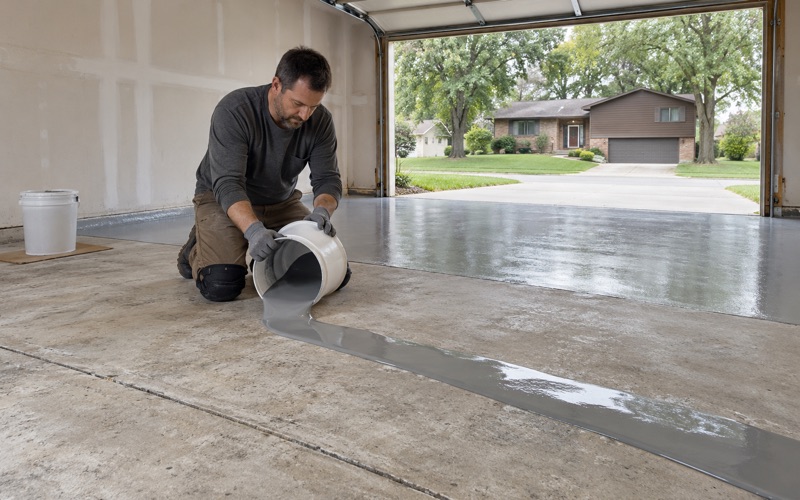
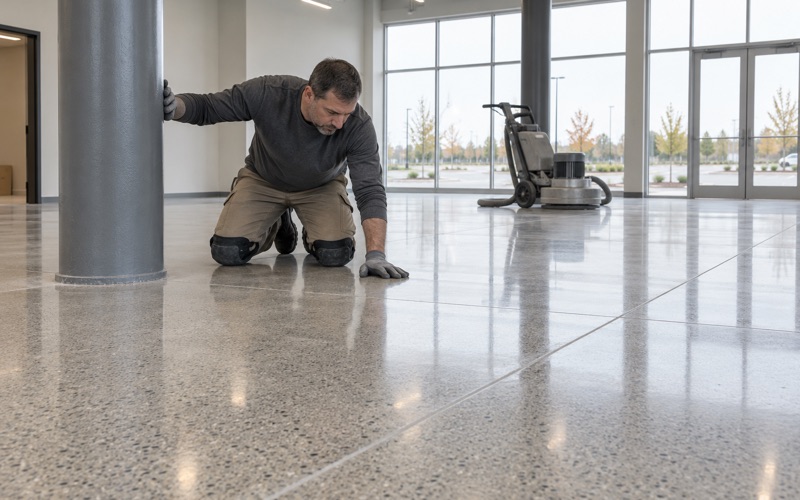
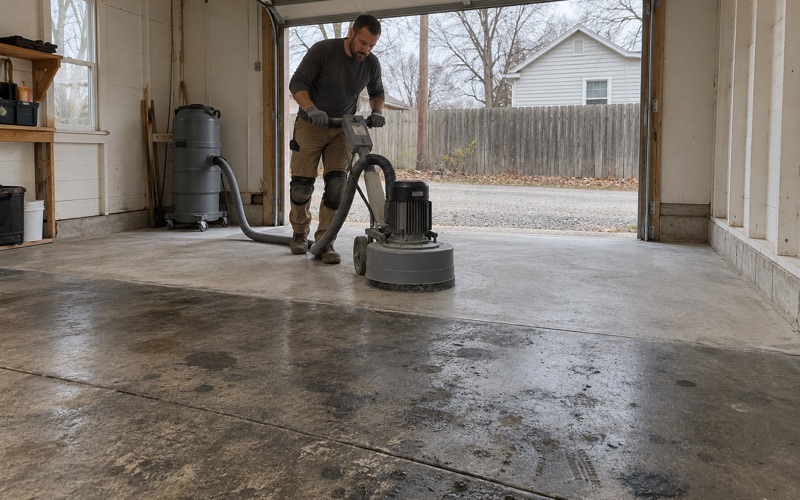
Our work starts at the slab, not the color chart. Every floor is opened with a diamond grinder or a shot blaster rather than acid, so the coating has a real profile to bond to, and a moisture test is written into the scope before the number is final. The proposal then names the product line, the coat count and the finished thickness.
That paperwork matters most in a building where many people have a say in the floor. A committee, a tenant program and a facilities volunteer can each read the same quote and check the finished floor against it. Below we walk through what a coated concrete floor can do in a multipurpose room, and where its limits are.
A Parish Hall on 66th Street That Also Hosts Basketball
Windsor Heights Lutheran Church and its 2013 expansion
Windsor Heights Lutheran Church, at 1240 66th Street, began building its church in 1947 and added on in 1959 and 1978. In October 2013 the congregation voted a renovation and expansion that renovated the sanctuary and added a new kitchen and parish hall. The church’s own history says the renovation allowed it to host programs from the local community.
Among those programs is Special Olympics basketball, alongside the Heartland Youth Choir. We have no connection to the church or to any program it hosts, and we have not seen the hall’s floor. We use it as an example because it states the question plainly: one room, built around a kitchen, also used as a court.
A building shared by several groups
The building is shared with Sethang Chin Baptist Church, and Easterseals Iowa uses it five days a week. That is a heavy weekly calendar for a single building. Meals, worship gatherings, day programs and games each put different demands on a floor, from rolling carts and dropped trays to steady foot traffic and the bounce of a ball.
In a building like that, nobody owns the floor alone. Any change has to be scheduled around groups that cannot simply stop meeting, and the decision about what the floor should be is usually made by people who will not be the ones standing on it every day. A clear written scope serves them better than a sales conversation.
Dining room or court: deciding the room’s main job
Before any product is chosen, the people responsible for a multipurpose hall have to rank its uses. If the room is a dining and gathering space that sometimes hosts a casual game, a hard, cleanable floor fits. If organized basketball is a regular, central use, the floor is being asked to perform as an athletic surface, and that is a separate category.
The same question comes up in the event halls along Hickman Road, where reception rooms host weddings, showers and corporate dinners. Those rooms are judged on looks and cleanup. A room that adds a court to that list picks up a second set of criteria, and those criteria are written down in a published standard.
Looking for epoxy-flooring closer to Clive? See Epoxy-Flooring Services in Clive.
What ASTM F2772 Measures on an Indoor Court
ASTM F2772 is the Standard Specification for Athletic Performance Properties of Indoor Sports Floor Systems. It sorts floors into five performance classes, Class 1 through Class V, by testing how the floor behaves under a player and a ball. What we know of it comes from published summaries of the standard, and we describe it at that level.
Force reduction
Force reduction measures how much of the impact of a landing the floor absorbs compared with concrete. Concrete is the reference because it is so hard: one summary puts its force reduction at about -1.9 percent, which means essentially none. Other trade summaries tie the Class II band to 22 to 33 percent force reduction.
That gap is the heart of the matter. A floor built for sport gets its cushioning from what sits under or within the playing surface, such as a resilient layer or a sprung subfloor. A thin film bonded tightly to a slab does not add that kind of give, so the concrete underneath still decides how the floor answers a landing.
Ball rebound and vertical deformation
Ball rebound compares how high a ball bounces on the floor with how high it bounces on concrete. The average of multiple drop points must meet or exceed 90 percent of the concrete rebound, and no single test point may differ from the average by more than 3 percent. A floor with soft spots or dead areas fails on consistency.
Vertical deformation measures the elasticity of a surface under an athlete’s foot or a heavy load. A sports floor is designed to give slightly and return. Concrete, coated or not, is designed not to move at all, which is exactly what makes it a good base for carts, tables and serving lines.
Surface friction and meeting all four
The fourth property, surface finish effect, measures a surface’s frictional properties, since a court has to let players stop and turn without sticking or sliding. Trade summaries say a floor must meet all four criteria to comply. Doing well on one, such as a grippy finish, does not make up for missing the others.
Why a Coating on Concrete Is Not a Sports Floor
A resin system bonded to concrete is a coating on the slab, not a new floor system above it. It changes how the surface looks, cleans and wears. It does not change how hard the slab is underneath, and that hardness is what the force reduction and deformation tests are measuring.
What epoxy changes and what it leaves alone
A 100% solids epoxy base with a polyaspartic or polyurea topcoat leaves concrete sealed, easy to mop and resistant to stains from dropped food and drinks. A urethane cement system goes further on heat and wet cleaning. None of these is presented by us as tested to ASTM F2772, and we will not describe any coating as a sports floor.
For a room where basketball is the main event, the sound advice is to talk with a supplier of athletic flooring systems. For a room where meals and gatherings come first, a coating can make concrete far easier to keep clean, and any game played on it is still a game played on hard concrete.
Slip resistance comes from the broadcast and topcoat
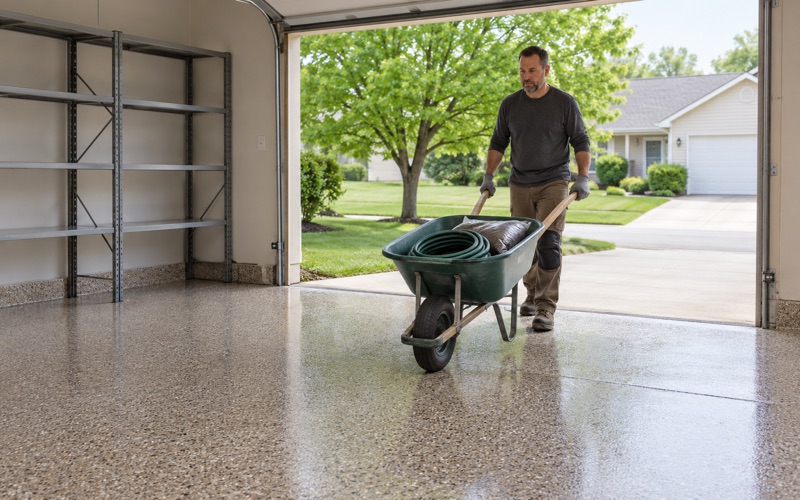
In a hall where people carry plates and children run, slip resistance matters, and we specify it by the materials rather than promising it. Texture comes from the broadcast, such as a quartz aggregate or a vinyl flake, and from the grit and topcoat chosen over it. More texture grips better when wet and takes more effort to mop.
That trade-off is worth deciding with the people who clean the room. A finish that suits a serving line may be heavier than the rest of the hall needs, and the proposal can show different textures in different zones. Whatever is chosen is written into the scope so it can be checked after the job.
Testing the slab before anything is promised
A hall slab is tested like any other. We use an ASTM F2170 in-situ relative humidity probe or an ASTM F1869 calcium chloride test, and the reading goes into the written scope before the price is final. Moisture is also the first exclusion we name when we explain what the coating warranty does not cover.
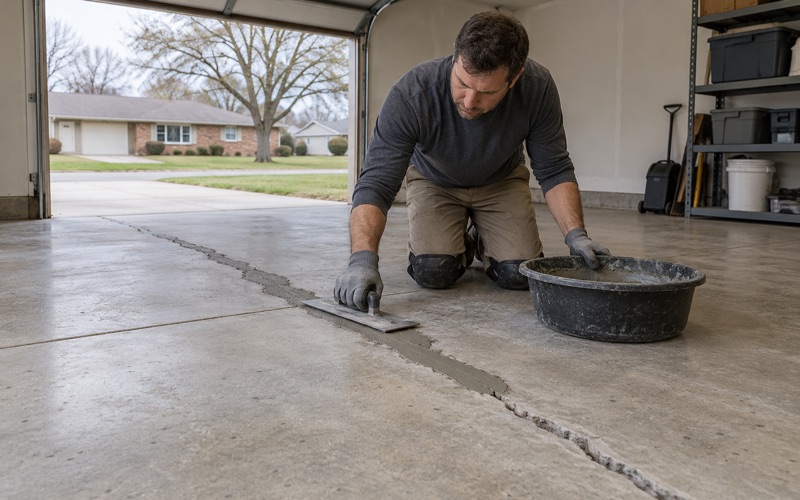
Cracks, spalls, control joints and any old coating are mapped before grinding starts. If the slab needs repair, or should not be coated at all, we say so in writing rather than covering a problem that will show through. Joints in a large room are carried through the new surface instead of being bridged with resin.
Kitchens, Serving Lines and Scheduling in a Shared Building
A building that several groups use every week brings practical limits that a single owner’s garage never does. The work has to fit around a calendar, the dust cannot travel, and the room must be ready on the day it was promised. Those limits shape the plan more than the product does.
Working around a weekly calendar
With programs running five days a week and two congregations sharing space, a hall coating is usually phased into overnight or weekend windows. We map which doors, hallways and restrooms each group needs, then plan the grinding, coating and cure so access is kept where it has to be. The schedule is agreed in writing before work begins.
Cure times follow the slab temperature and the dew point spread at the surface, not a calendar date. If the building’s heat is turned down between events, the coating may need longer before tables and carts return. We would rather ask a group to wait a day than have chairs dragged across a soft topcoat.
Dust, odor and occupied rooms
Grinding dust is captured at the machine with a vacuum, not swept or rinsed toward a floor drain. In a building where a day program meets down the hall, that matters. Low-odor products are available as a comfort and re-entry choice, and we explain that they are an option, not a legal requirement in Iowa.
The kitchen edge and the serving line
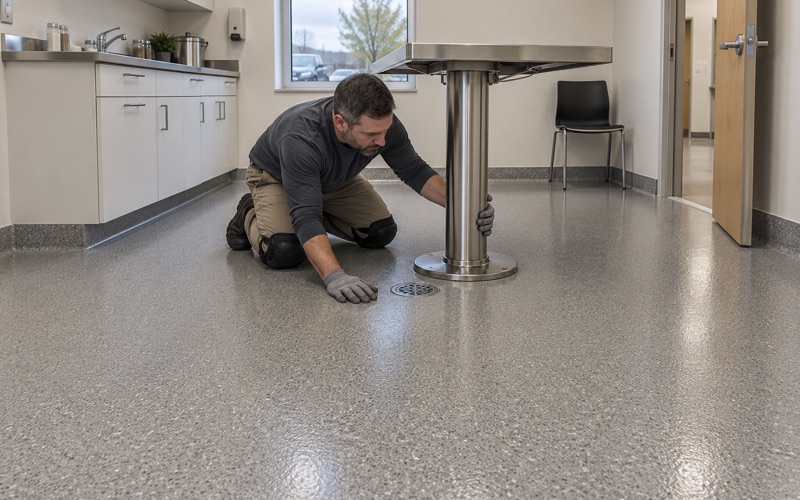
The area next to a kitchen sees spills, cart traffic and frequent wet mopping. A coating there is chosen for cleanability and wet slip resistance, and an integral cove base can carry the floor a few inches up the wall so water does not sit at the joint. Floor drains are coated around, never sealed over.
Permits and who signs off
In Windsor Heights, building permit applications go to the Deputy City Clerk, and the city contracts permit and inspection services to Safe Building Iowa. Whether a coating on an existing floor needs a permit was not addressed on the city’s page, so we confirm that with the city before scheduling rather than assume either answer.
We also keep the line clear between flooring and other trades. A floor coating is not waterproofing or flood protection, and a sewer backup through a floor drain is a call to the city’s Public Works department before anyone talks about coatings. We start once leaks and drains are sorted out.
- 20+ Years on Iowa Concrete
- Moisture Tested in Writing
- Free Estimates