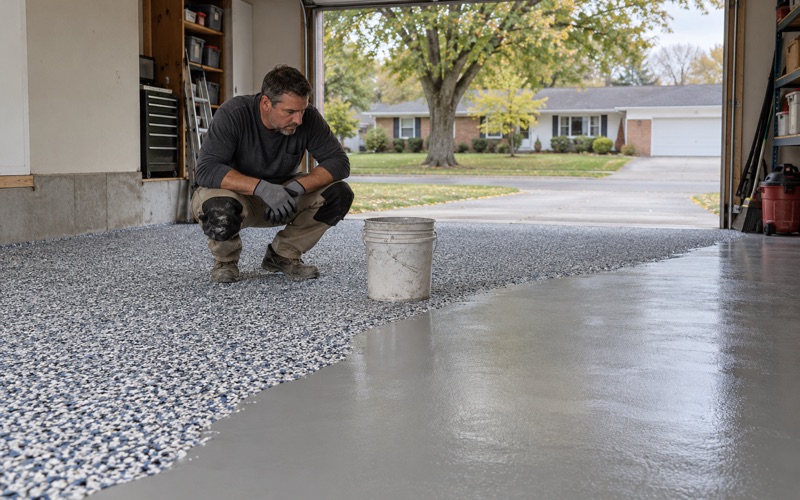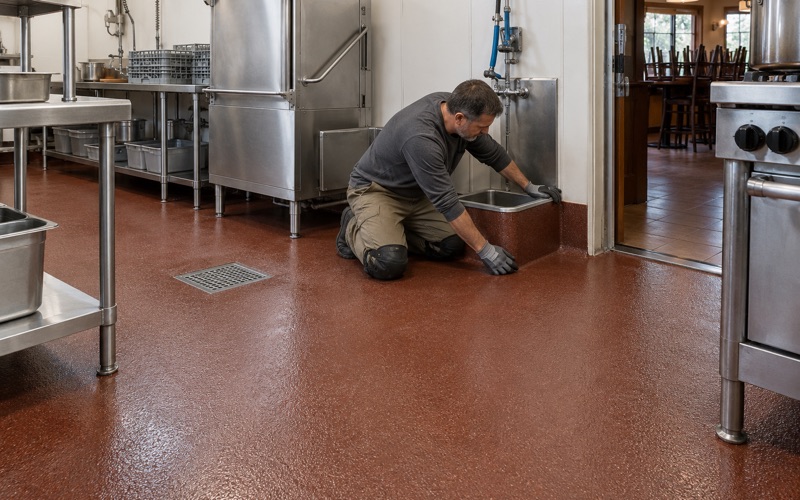
Ames Epoxy Flooring has spent more than 20 years on epoxy flooring in Urbandale and across central Iowa, and a growing share of the questions we hear are about ground concrete rather than a poured coating. Owners want to know whether the slab they already have can become the finished floor. The honest answer starts with that slab, not with a brochure or a sample board.
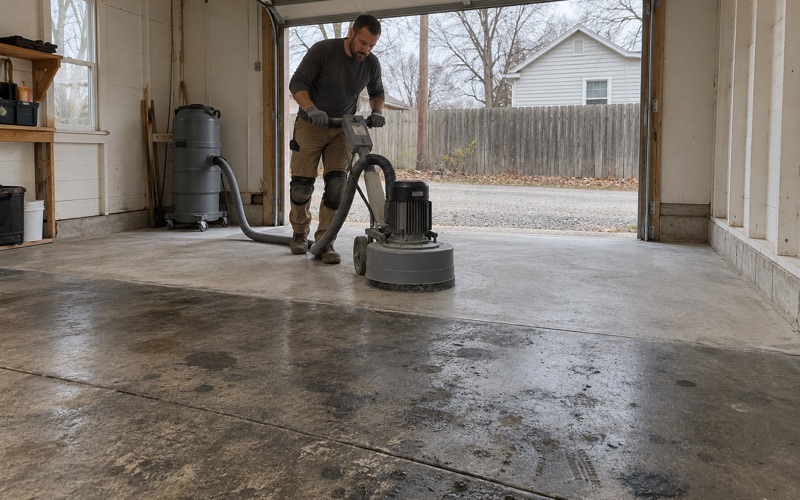
Our work begins the same way on every floor, whether the plan ends in a 100% solids epoxy system or a polished, exposed surface. We open the concrete with a diamond grinder, capture the dust at the machine with a vacuum, and map cracks, spalls, joints and old coatings before anyone talks about a finish. That map is our first read on what grinding is likely to reveal.
A moisture test belongs in the written scope before a price is final, and the proposal names the product line, the number of coats and the finished thickness. On a ground floor it also names the densifier, the grout pass and the exposure class. You can hold the finished room up against the quote line by line, rather than against a photo of somebody else’s building.
A Furniture Showroom on an Old Factory Floor
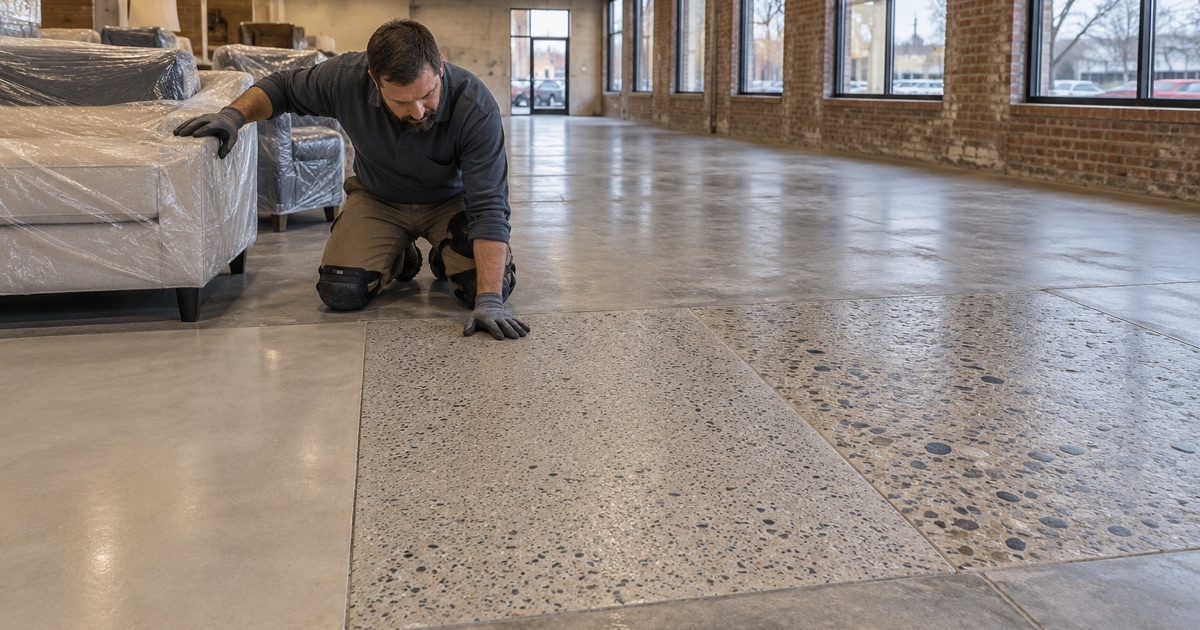
One of the better-known commercial floors in town belongs to the Homemakers Furniture store at 10215 Douglas Avenue, near the corner of 100th Street. The Merschman family bought the former Parker Brothers factory there in 1985 and opened a second store on the edge of Urbandale. The building has been expanded and rebuilt several times since, including a renovation and rebuild completed in 2009.
Carpet and Tile Out, Aggregate Concrete In
In March 2022 the company announced it would replace all of the carpet and existing tile in its 215,000-square-foot showroom. About 31 percent of the new flooring was to be aggregate concrete, with plank tile across the rest. The work ran in enclosed phases while the store stayed open, and the company reported the renovation complete in fall 2023.
We had no part in that project and have no relationship with Homemakers. We point to it because it is a local, public example of a choice more Urbandale owners are weighing: keep the structural slab, grind it, and let the stone inside it become the floor. Which exposure class the store chose, and how its slab ground out, were never published.
What a Reused Factory Slab Carries
A slab that has served as a factory, then a store, then a rebuilt store usually carries that history in the concrete. Infill where equipment once stood, patches over old trenches, and areas finished by different crews in different decades tend to grind out unevenly. A coating hides those differences under one uniform color. A ground finish puts every one of them on display.
That is the core trade-off on an older commercial slab. An epoxy or urethane cement system can make a patched floor look consistent, while an exposed finish rewards a slab that was placed well and penalizes one that was not. We read the concrete first and tell you which way it leans before you commit to a look you cannot take back.
Looking for epoxy-flooring closer to Windsor Heights? See Epoxy-Flooring in Windsor Heights.
Cream, Salt and Pepper, or Full Aggregate
The Concrete Polishing Council, part of the American Society of Concrete Contractors, publishes an aggregate exposure chart that gives owners and contractors a shared vocabulary. Its 2024 edition sorts exposed and polished concrete into three classes by what shows at the surface. Naming the class in a proposal keeps everyone describing the same floor rather than three different ideas of one.
Class A: Cream Finish
Class A is cement fines, usually called a cream finish. The chart describes the surface as 85 to 95 percent cement fines, with 5 to 15 percent fine aggregate showing through. The grinding stays shallow, close to the top paste, so the floor reads as a smooth, mostly solid tone with a light scatter of sand across it.
Cream suits a slab whose top surface is sound and consistent, because the grind does not go deep enough to hide much. It also keeps more of the original paste in place. The catch is that trowel marks, discoloration and patching in that paste stay visible, so we study the surface closely before we recommend this class for any room.
Class B: Salt and Pepper
Class B, fine aggregate, is the salt-and-pepper look. The chart puts it at 85 to 95 percent fine aggregate at the surface, a speckled field of sand particles with very little large stone. It takes a deeper cut than cream, which removes more of the paste and, with it, some of the surface flaws a cream finish would keep.
Class C: Full Aggregate
Class C is full aggregate exposure, with 80 to 90 percent of the surface showing the larger stone in the mix. This is the look most people picture when they say exposed aggregate. It takes the deepest grind, and it depends entirely on how much coarse stone sits near the top of the slab and how evenly it settled when the concrete was placed.
Full aggregate is the class where an old slab’s history is hardest to hide. A patch poured with a different mix shows a different stone, or none at all. Where we expect a full-aggregate result to look patchy, we say so in writing and offer a cream or salt-and-pepper class, or a coated system, as the honest alternative.
Why the Existing Slab Decides What Shows
Grinding does not add stone to a floor. It only uncovers what the concrete already holds, which is why the same exposure class can look very different on two slabs across the street from each other. Before quoting an exposed finish in Urbandale, we treat the existing slab as the material being sold, because in practical terms that is exactly what it is.
Mix, Placement and Finishing
The chart is direct about this: the density, size and distribution of aggregate at the surface result from the concrete mix design and from how the slab was placed and finished. A heavily troweled floor can push stone down and leave a thick layer of paste on top. A mix with small stone cannot produce a bold full-aggregate look however long the grinder runs.
In an existing building, nobody chose that mix with polishing in mind. A slab poured decades ago for a plant or warehouse was designed to carry loads, not to be admired. That is why we map the cracks, spalls and joints, run a moisture test and note old coatings before any grinding, so the exposure question is asked about this slab specifically.
Flatness Shapes the Class
Specified flatness, the FF and FL numbers, also matters when choosing a class. A wavy floor grinds unevenly: the machine cuts deeper into the high spots and barely touches the low ones, so a single room can show full aggregate on the crowns and cream in the dips. A flatter slab gives a more uniform exposure at whichever class is chosen.
Color That Moves as Paste Comes Off
Color is not fixed either. The chart notes that a Class A floor that starts out gray may turn brown as paste is removed, because the cement and sand underneath carry their own tones. We do not promise an exact color match to a sample board or to another building, and the exposure percentages are a guide rather than a guarantee.
Mock-Ups, Grout and Old Repairs Under a Ground Finish
Every point so far leads to the same practical step. The look of an exposed floor is decided by the floor itself, so the decision gets made there too. That step costs a little time at the start of a job and saves an argument at the end about whether the finished room matches what everyone expected to see.
A Mock-Up on the Actual Slab
The chart says mock-up samples should be done on the actual slab to be polished rather than off site. We grind a test area in a representative part of the room, often beside an old patch or a joint, through the same steps the full floor will get. You see the real stone, the real color and the real flaws before signing off.
A mock-up also tests the job itself. It shows how much fine dust our vacuum-captured grinders leave behind, how long each pass takes on this concrete and how hard the slab really is. That turns an estimate of production hours into a measured one, which matters most when the floor sits under a business that has to keep working.
Measured in a 10-Foot Square
The exposure percentages in the chart are measured in a randomly placed 10-foot by 10-foot square, not in the best-looking corner of the room. We use the same method to judge the mock-up and the finished floor. If a proposal names a class, it should also say how that class will be checked, so neither side is grading a handpicked spot.
Grout for Pores and Pinholes
Under the chart, floors with pore defects such as sand pop-outs, micro cracking, pinholes and air voids will require grouting, as will floors processed to a specified exposure. Grinding opens those voids, and an ungrouted floor collects dirt in every one of them. The grout pass goes into the written scope and the price, not into a later change order.
Patches and Old Repairs
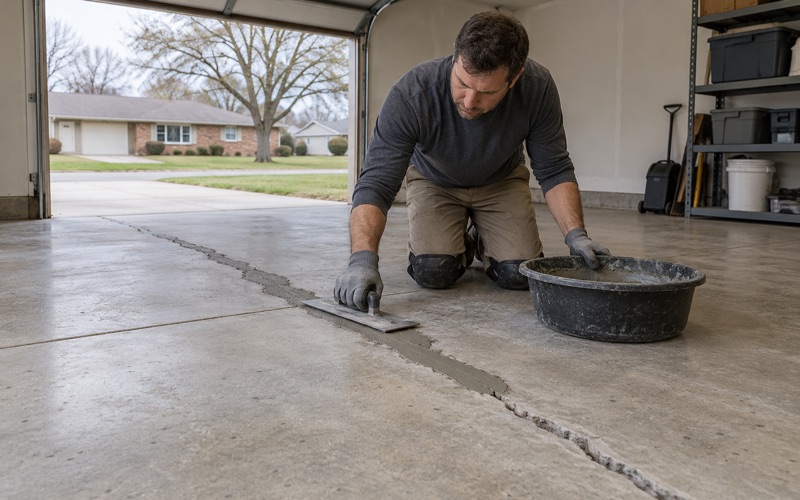
Old repairs are where an exposed floor in a reused building is most likely to disappoint. A patch can grind out as a flat gray island in a field of stone, and a filled trench can show as a straight seam. We mark those on the crack map and decide with you whether to accept them, rework them or choose a coated finish instead.
When a coating is the better answer, the slab still gets opened by diamond grinder or shot blaster, never an acid etch, so the system has a real profile to grip. When grinding is the answer, a lithium silicate densifier hardens the surface after the grout pass. Either way, you know which path the floor is on before the first pass begins.
- 20+ Years on Iowa Concrete
- Moisture Tested in Writing
- Free Estimates