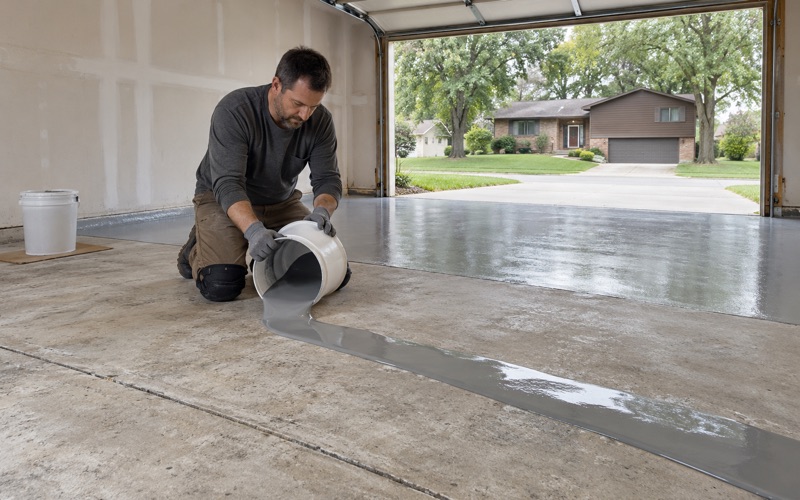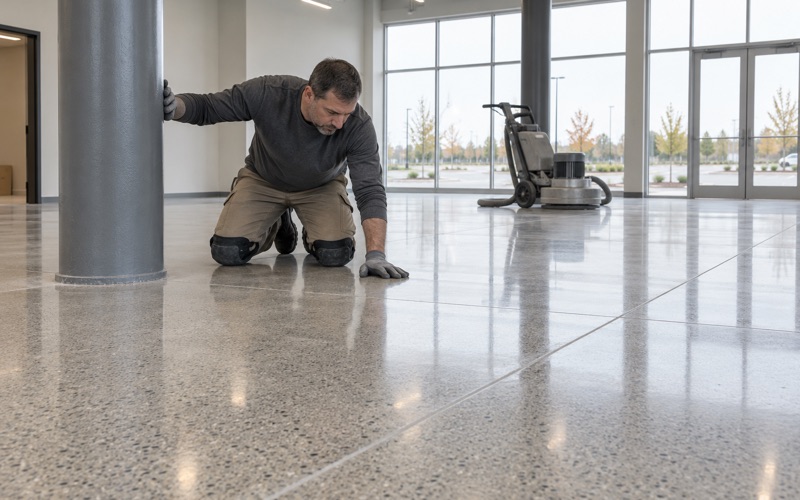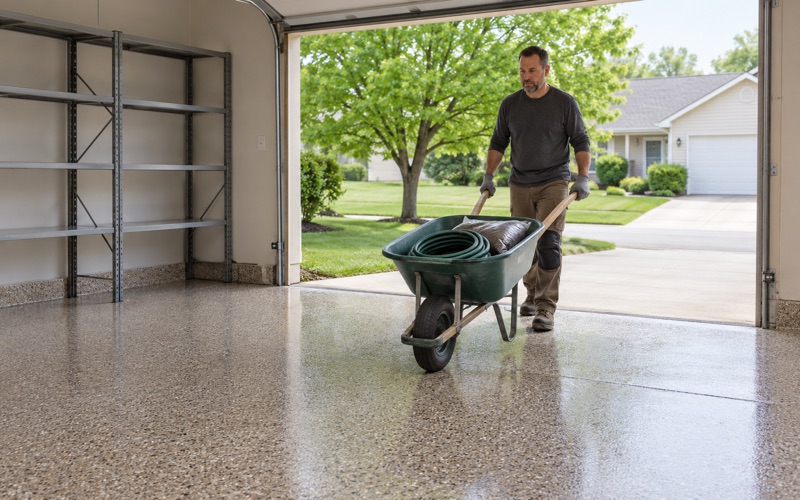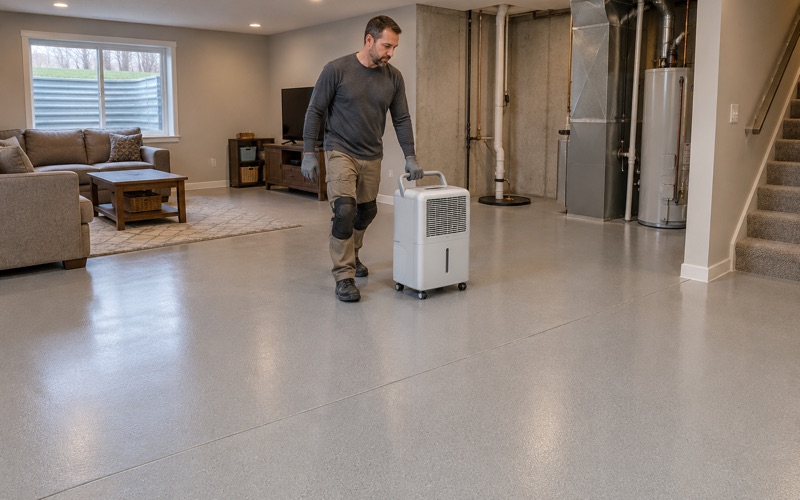
Ames Epoxy Flooring brings more than 20 years of epoxy flooring in Saylorville to garage and basement slabs, and on older homes here the first question is often not which coating to choose. It is what is already on the floor. A gray or red painted floor from decades ago changes how the job has to start, and we plan for that before any grinder is unloaded.
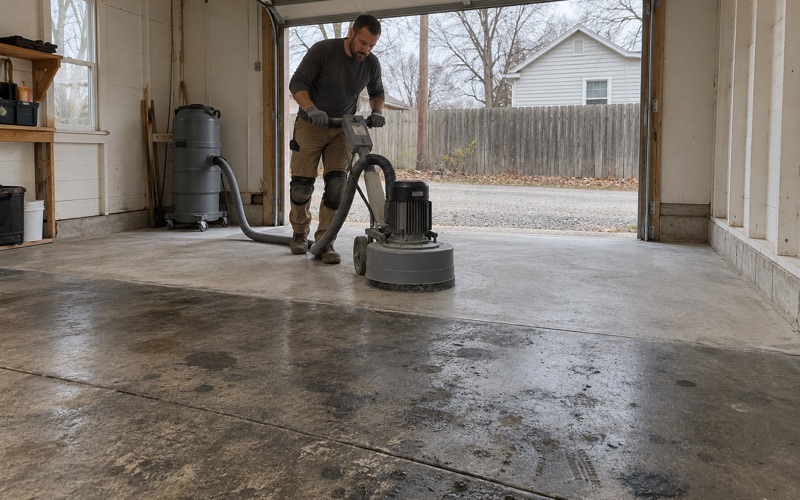
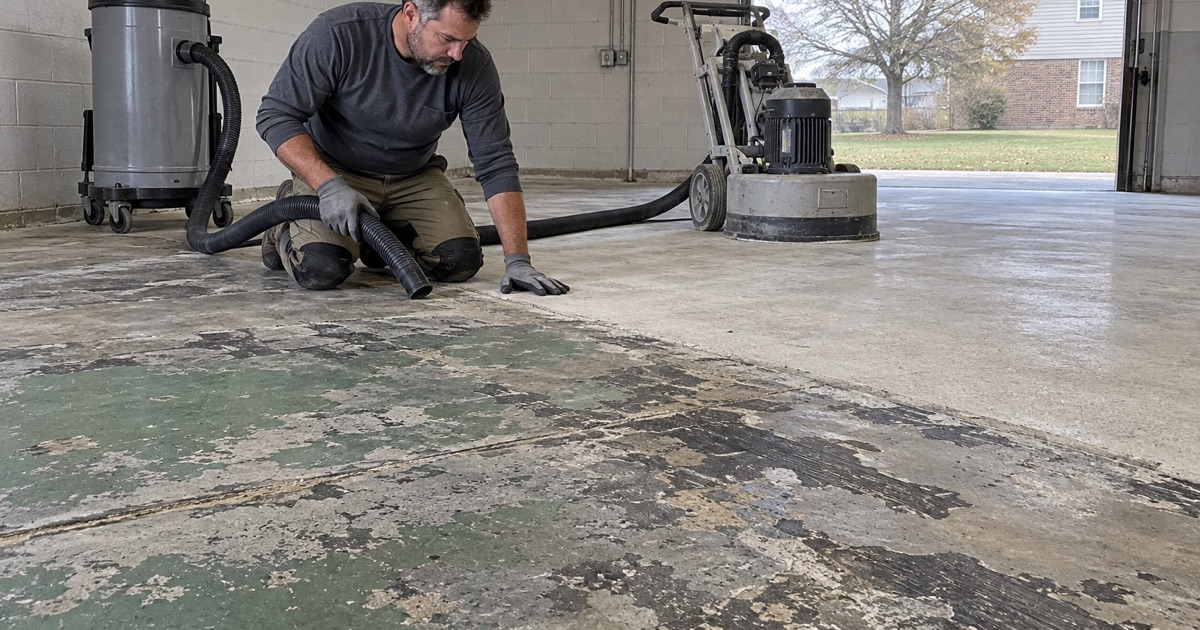
Our approach to every slab is mechanical. We open the concrete with a diamond grinder or a shot blaster rather than an acid etch, because a coating needs a real surface profile to grip. That same grinding is exactly what makes an old painted coating worth a closer look first, since grinding turns a finish into dust.
This page walks through how Iowa’s lead-based paint rules treat floors and garages, why an old painted floor is tested before it is ground, how removal dust is controlled, and how the new floor is coated once that question has an answer. It also says plainly what a coating can and cannot do for an older house.
Saylorville’s Older Houses and Iowa’s 1978 Line
Saylorville is a census-designated place in Saylor and Crocker townships of Polk County, part of the Des Moines-West Des Moines metro area. It has no city government, and its housing is overwhelmingly detached, owner-occupied homes. That mix means most of the floors we see here are private garages and basements, many of them older than their owners.
A Housing Stock That Peaked in the 1960s
Census estimates count 1,391 housing units in the Saylorville CDP, and 758 of them were built before 1980. The single largest decade is the 1960s, with 437 units, followed by 143 homes from 1939 or earlier. Ownership runs about 93.7 percent, so the typical floor belongs to the household that lives above it.
The decade bins in that survey do not split at 1978, so the number of homes built before 1978 is somewhat below 758. Even so, a majority-older housing stock means a painted garage floor or a painted basement slab is a common starting point here, not an oddity, and the scope has to account for it.
What 481 IAC Chapter 470 Says About Floors
Iowa’s lead-based paint rules sit in 481 IAC chapter 470, administered by the Department of Inspections, Appeals and Licensing (DIAL). The definitions list interior and exterior floors as building components. A painted component is one at least partially covered with paint or other surface coating, and lead-based paint is defined as paint or other surface coatings above set lead levels.
Those definitions do not single out wood or plaster. Read together, they place an old coating on a concrete floor inside the same vocabulary as paint on a wall. DIAL’s own lead page does not mention painted concrete floors; the connection comes from applying the rule’s definitions, and we present it that way.
Garages Count as Part of the Dwelling
The same chapter defines a residential dwelling to include attached structures and detached buildings, naming garages specifically. A detached garage behind a Saylorville house is therefore part of the dwelling under the rule, not a separate outbuilding outside it. For a house built before 1978, that puts the garage floor in the same frame as the rooms inside.
DIAL describes target housing as housing built before 1978, and it states that companies doing renovation there must be certified as a lead-safe renovator firm, with at least one certified lead-safe renovator assigned to each job. Renovation, in the rule’s words, includes surface preparation such as sanding or scraping that may generate paint dust.
Looking for epoxy-flooring closer to Bondurant? See Epoxy-Flooring Services in Bondurant.
Testing an Old Painted Floor Before It Is Ground
Grinding is the step that makes a floor coating last, and it is also the step that turns an old finish into airborne dust. That is why the sequence on an older Saylorville slab starts with a question about the existing coating rather than with the machine. We map the old coating along with cracks, spalls and joints before quoting.
Why the Test Comes First
DIAL’s lead page states that surfaces tested and determined not to be painted with lead-based paint are exempt, and that the testing requires documentation and certification. In practical terms, a documented result on the old floor coating decides which path the removal takes. Without one, grinding a painted floor in a home built before 1978 is a guess.
We do not hold lead-safe renovator certification, and we do not test paint ourselves. When a painted floor in an older home is on the table, we say so at the walkthrough and point the owner toward getting the coating tested by a certified party before any surface preparation is scheduled. The coating work waits on that answer.
Telling Old Paint From Old Epoxy
Not every old floor finish is paint in the everyday sense. Some garages carry a thin one-part epoxy from a hardware store, some carry porch and floor enamel, and some carry layers of both. The rule’s definition covers paint or other surface coatings, so the label on a can found in the rafters does not settle the question.
What we can tell an owner is how the coating is bonded, where it is peeling, and how much of the slab it covers. That mapping shapes the bid either way. A well-bonded layer and a flaking one demand different removal effort, and both get written into the scope with the area measured rather than estimated.
Newer Floors Still Get a Look
A floor known to have been poured after the late 1970s and never painted is a simpler start, and Iowa’s inspection rules themselves set aside components known to have been replaced after December 31, 1977. Even then, we look at the slab’s history. A newer slab may have been painted later, and a newer house is not automatically a drier garage.
Records help here. A builder’s date, an old receipt or a known slab replacement can narrow the question quickly, and we would rather an owner bring that history to the walkthrough than have us assume it. Where nothing is known about the coating’s age, the sound plan is to treat it as unknown until a test answers it.
Dust-Controlled Removal When the Old Paint Is Lead-Based
If testing shows the old floor coating is lead-based paint, removal becomes renovation work under the state rule and belongs with a firm certified for it. Our part changes accordingly: we coordinate around that work rather than performing it, and we do not begin our own grinding until the old coating question has a documented answer.
What the Rule Treats as Dust-Generating Work
Chapter 470 defines dry sanding and dry scraping to include hand and mechanical methods, which covers a walk-behind grinder as squarely as a hand scraper. It also sets a dust-lead hazard level for floors at 5 micrograms per square foot. Those numbers belong to the certified lead-safe renovator and the clearance process, not to a coating crew’s judgment.
How the rule’s minor repair thresholds, written for painted wood, drywall, plaster and exterior surfaces, apply to a painted concrete floor is not something we interpret for an owner. A garage floor runs to hundreds of square feet, and any reading of those limits for a specific job is a question for DIAL or a certified firm.
Capturing Dust at the Machine
On every floor we grind, tested clear or newer, grinding dust is captured at the machine with a vacuum rather than swept up afterward or rinsed toward a floor drain. In a basement that matters for the air in the house, and in a garage it keeps fines out of the driveway and the storm inlet at the curb.
Shot blasting works the same way, with the blaster feeding spent media and debris into a collector. Neither method is offered as a substitute for lead-safe work practices. They are simply how we prepare concrete everywhere, and they keep the house cleaner on a job where the old coating has been shown not to be lead-based.
Planning the Calendar Around Removal
When a certified firm handles removal first, the floor reaches us bare, and the scheduling question becomes cure and conditions. We set a start date once the removal and any cleanup the firm requires are finished. Owners in this situation usually find the coating portion is the shorter of the two jobs.
Where the test result clears the old coating, our own crew can grind it off as part of surface preparation, and the job runs as a single project. Either way, the profile we aim for is an ICRI concrete surface profile matched to the system, and it is checked before the first coat goes down.
Coating the Floor Once the Paint Question Is Settled
With the old finish answered and removed, a Saylorville floor is coated the same way we coat any slab: tested, profiled, and built to a written specification. It is worth being direct about one point. A new epoxy system over a once-painted floor is a floor finish, not a lead hazard control and not a cover for old paint.
Moisture Testing Is in the Written Scope
Before the price is final, the scope includes a moisture test, whether the slab is in a 1960s basement or a newer garage. Depending on the floor, that can be an ASTM F2170 in-situ relative humidity probe or an ASTM F1869 calcium chloride test. Basements are also read for past water, with the sump pit and floor drain checked.
A coating does not stop seepage, and the warranty exclusions are explained before the job is sold. Moisture vapor transmission and hydrostatic pressure are the first ones we name. Where readings come back high, a moisture-mitigation primer may be specified, and where a slab needs repair or replacement first, we say that rather than coat over the problem.
Systems Built for Central Iowa Garages
Garage systems are chosen for the brine and rock salt that ride in on tires through the winter. A common build is a 100% solids epoxy base with a vinyl flake broadcast and a polyaspartic topcoat, which also resists hot tire pickup. Slip resistance comes from the broadcast and topcoat specified, not from a promise.
The proposal names the product line, the number of coats and the finished thickness, so the finished floor can be checked against the quote. Low-odor products are available for attached garages and basements as a comfort and re-entry choice. They are an option an owner may prefer, never presented as something Iowa requires.
Curing on Slab Conditions, Not the Calendar
Cure schedules follow slab temperature and the dew point spread at the slab surface, not a date picked in advance. An unheated detached garage in a central Iowa winter is told to wait for warmer conditions. A heated basement can usually be coated year-round, provided the moisture readings and surface profile both check out on the day.
Because Saylorville has no city building department, permits for new construction and additions here run through Polk County Public Works, whose Building Services office inspects under the Polk County Construction Code. If the floor is part of a garage addition or a new slab, that county office is the one to ask before the concrete is poured.
- 20+ Years on Iowa Concrete
- Moisture Tested in Writing
- Free Estimates