
Ames Epoxy Flooring applies polyaspartic floor coating in Ames, IA and in surrounding cities including Ankeny, Boone, Nevada, Huxley and Polk City. Polyaspartic is a fast-curing coating chemistry, a relative of polyurea, that brings a hard, abrasion-resistant and color-stable surface to garage, basement and commercial floors in far less time than a traditional epoxy system takes.
That speed is the main selling point, and it is also the main risk. A coating that grabs within minutes leaves no room for a slab that was not ground properly, still holds moisture, or is sitting too close to the dew point. After more than twenty years of coating central Iowa concrete, we treat polyaspartic as a material that rewards careful prep more than any other, rather than a shortcut around it.
Your written proposal names the polyaspartic product line, whether it goes on as a full system or as a topcoat over epoxy, the number of coats and the finished thickness. It also lists the warranty exclusions, starting with moisture, so you know what the floor is and is not built to handle.
What Polyaspartic Does Well
Fast Cure and Quick Return to Service
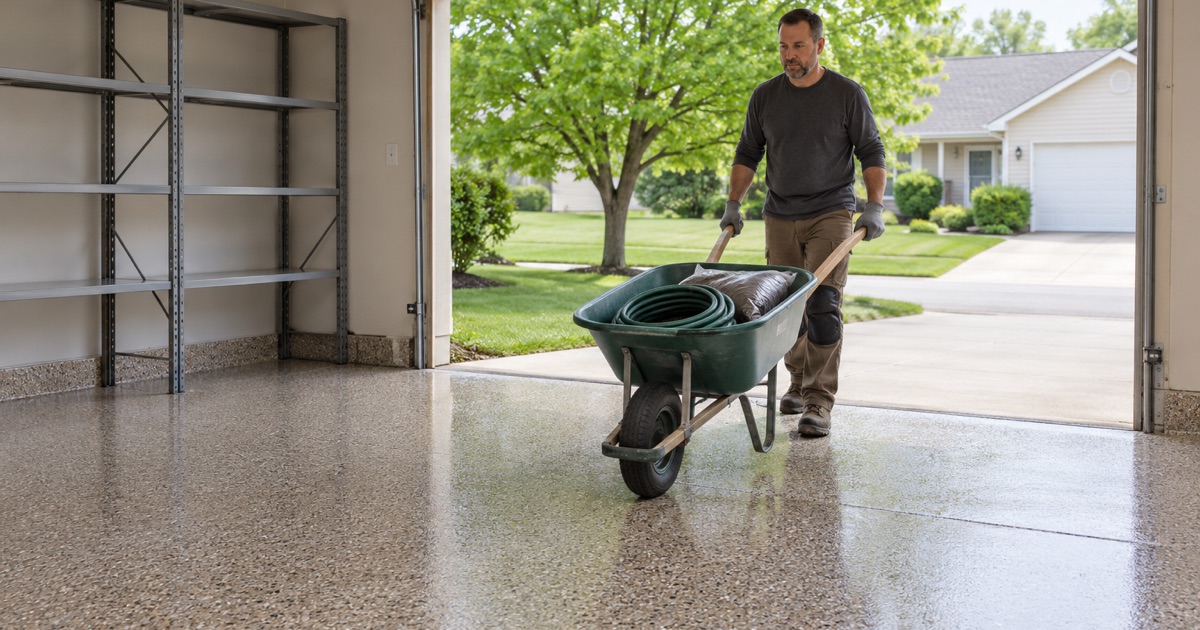
Polyaspartic cures much faster than most epoxies, so coats can follow each other the same day and the floor goes back into use sooner. For a business that cannot close for long, or a homeowner who needs the garage back quickly, that time saving is often the deciding factor.
The fast cure also shortens the window when dust, insects or humidity can settle into a wet coat. On a commercial job phased overnight, it lets a section be coated after closing and walked on by morning.
Color Stability in Sunlight
Standard epoxy ambers under ultraviolet light, which shows as a yellowed band near garage doors and windows. Aliphatic polyaspartic resists that color shift, keeping light grays and bright flake blends looking the way they did on install day.
This is why we specify a polyaspartic topcoat on almost every floor that sees daylight, even when the base coat underneath is epoxy. The base handles bond and build; the topcoat handles the sun.
Abrasion and Chemical Resistance
A cured polyaspartic topcoat is tough against scuffing from sand, salt, boots and tires, and it resists many common automotive fluids and cleaners. In a garage, that means the surface keeps its sheen longer under daily parking and winter grit.
No coating is indestructible, and sharp dropped tools or dragged equipment can still mark it. A broadcast of flake or quartz under the topcoat spreads that wear across a textured surface rather than a smooth film.
Polyaspartic Systems We Install
Epoxy Base With Polyaspartic Topcoat
Our most common system pairs a 100% solids epoxy base with a polyaspartic topcoat. The epoxy has a longer working time, which lets it wet out the ground concrete and build thickness, while the polyaspartic gives the hard, UV-stable wear surface on top.
Flake or quartz is broadcast into the epoxy base while it is wet, then sealed under the polyaspartic. It is a balanced system for garages, basements and light commercial floors that need both bond and durability.
Full Polyaspartic Systems
On the right slab, polyaspartic can be used for every coat, from primer to topcoat, which cuts the install time the most. That suits dry, sound concrete with little repair work and conditions within the product’s range on the day of install.
We only recommend a full polyaspartic system when the moisture test and slab walk support it. Where the slab is borderline, the epoxy base with a moisture-mitigation primer is the safer choice, even if it adds a day.
Topcoating an Existing Floor
A worn but well-bonded coating can sometimes be sanded and topcoated with polyaspartic to restore its gloss and protection. It is a lower-cost refresh for a floor that has lost its shine without failing.
If any part of the old coating is peeling, lifting or blistered, it all has to come off first. A new topcoat bonds to whatever is beneath it, and it cannot hold down a base that is already letting go.
Prep and Conditions Polyaspartic Demands
Diamond Grinding to a Real Profile
Polyaspartic penetrates and bonds quickly, so the concrete has to be clean and open before it arrives. We diamond grind or shot blast every slab to an ICRI concrete surface profile, never relying on an acid etch that leaves a shallow, uneven texture.
Grinding dust is captured at the machine by a vacuum. It stays out of the house and out of floor drains, and the slab is vacuumed again before the first coat goes down.
Moisture and Dew Point on the Day
A fast-curing coating has less time to tolerate moisture coming up through a slab, which can show up later as blisters or bubbles. Every slab is moisture tested before the price is final, and the readings decide whether a mitigation primer belongs in the system.
On install day we also check the dew point spread at the slab surface. If the slab is too cold or too close to the dew point, we do not coat, whatever the schedule says.
Working Time and Crew Experience
Because polyaspartic sets quickly, it has to be mixed in measured batches and spread before it starts to gel. Lap marks, roller lines and missed spots are hard to fix once it cures, so the crew works in a planned sequence from the far wall toward the exit.
That pace is why we never rush a job by adding square footage to a single mix. Smaller batches applied correctly give a more even finish than large batches pushed past their working time.
Where Polyaspartic Fits Best
Garages Facing Iowa Winters
In a garage, the polyaspartic topcoat is what faces the brine, rock salt and tire heat every day. It resists those deicers and holds up to hot tires better than a thin epoxy paint, especially over a broadcast flake base.
Cold weather still matters. An unheated garage in a central Iowa winter usually waits for spring, because even a cold-tolerant coating needs the slab inside its range to cure properly.
Basements, Sunrooms and Showrooms
Polyaspartic’s color stability makes it a good fit where daylight reaches the floor, such as walkout basements, sunrooms and retail showrooms. A low-odor formulation helps in occupied homes and businesses.
In basements, the moisture test comes first, as it does for every coating. Polyaspartic does not stop seepage or radon, and we never sell it as either.
Commercial Floors on a Tight Schedule
Shops, clinics, offices and retail spaces often choose polyaspartic because the floor can be coated after closing and reopened sooner than an epoxy system allows. Large floors are split into sections so part of the building stays in use while another is prepped and coated.
The proposal sets out the phase plan, the cure time each section needs before traffic, and which areas are closed on which nights. Slip resistance in wet zones is specified by the broadcast and topcoat used, not left to chance.
Our Step-by-Step Polyaspartic Floor Coating Process
Step 1: Slab Walk, Moisture Test and Proposal
We measure the floor, map cracks, joints and any old coating, and run a moisture test. The written proposal follows, naming the product line, whether the system is full polyaspartic or an epoxy base with a polyaspartic topcoat, the coats, the finished thickness and the warranty exclusions.
Step 2: Grinding, Repair and Cleaning
The slab is diamond ground or shot blasted with dust captured at each machine. Cracks, spalls and joints are filled and ground flush, then the whole floor is vacuumed so nothing loose sits under the first coat.
Step 3: Base Coat and Broadcast
The base coat goes down in measured batches, and on a decorative system, flake or quartz is broadcast into it while wet. After it cures, the excess is scraped and vacuumed off to leave an even texture.
Step 4: Polyaspartic Topcoat and Return to Use
The polyaspartic topcoat is applied after a final check of slab temperature and dew point. We leave you the dates for foot traffic, light use and vehicles, plus care notes for keeping salt and grit off the finish through the first winter.
- 20+ Years on Iowa Concrete
- Moisture Tested in Writing
- Free Estimates