
Ames Epoxy Flooring grinds and finishes polished concrete floors in Ames, IA, serving surrounding cities including Nevada, Huxley, Boone, Polk City and Ankeny. Where a coating adds a layer on top of the slab, polishing works the slab itself: the surface is ground flat, hardened with a densifier and refined with progressively finer diamonds until it reflects light.
That makes a polished floor one of the lowest-maintenance surfaces a building can have, with no film to scratch through, peel or recoat. It also means the finished floor depends entirely on the concrete you have, which is why we grind a test patch before quoting and show you how your slab responds.
With more than twenty years of grinding central Iowa concrete behind us, we can usually tell from that patch whether a slab will polish well, needs repair first, or would be better served by a coating. You get that answer before any money is spent on the full floor.
How a Polished Concrete Floor Is Made
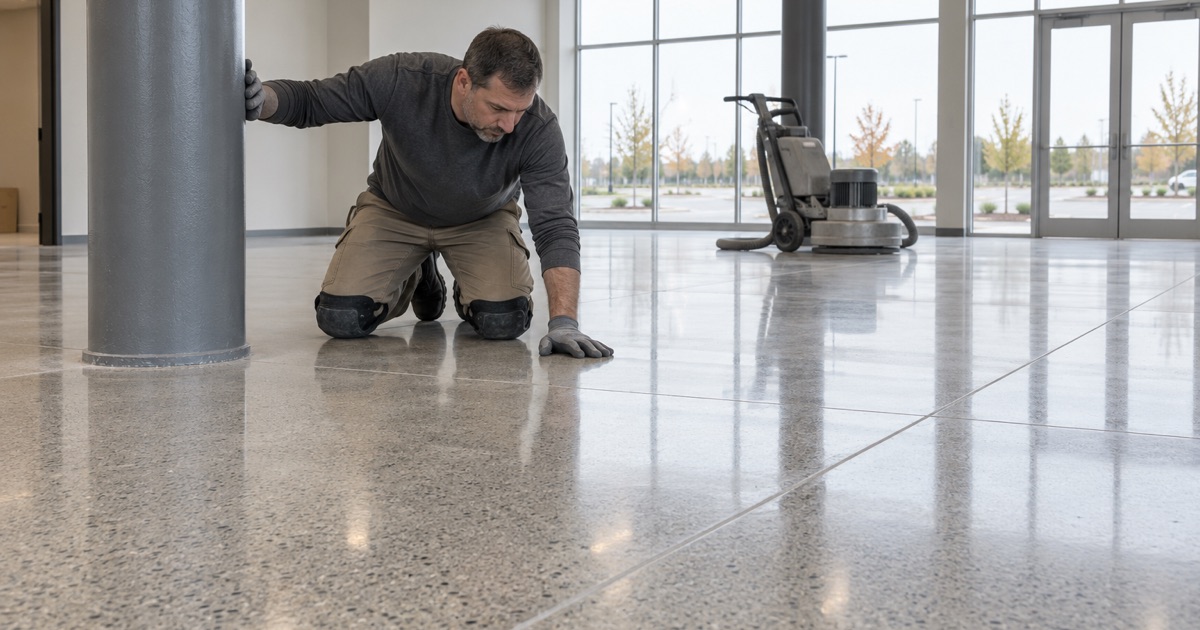
The Grind Sequence
Polishing starts with coarse metal-bond diamonds that flatten the slab and cut through the top layer of cement paste. Each pass that follows uses a finer grit, removing the scratches left by the one before it, until resin-bond diamonds bring the surface up to the chosen sheen.
Skipping steps leaves scratch patterns that show under raking light, especially near windows and overhead doors. We step through the sequence completely, even when it takes longer, because the finest grit can only polish what the coarse grits flattened.
Lithium Silicate Densifier
Partway through the grind, a lithium silicate densifier is applied to the open concrete. It reacts with the free lime in the slab to harden the surface, which tightens the pores, reduces dusting and lets the later grits produce a deeper shine.
The densifier is what turns a ground slab into a hard-wearing floor. It is absorbed into the concrete rather than sitting on top, so there is nothing to wear through over time.
Guard and Final Burnish
After the final polish, many floors get a penetrating guard that adds stain resistance against oil, coffee and similar spills. It is burnished in with a high-speed machine, which heats it into the surface and sharpens the reflectivity.
The guard is a maintenance layer rather than a coating, and it can be refreshed by burnishing years later. We tell you which guard we use and how it should be cared for.
Choosing Aggregate Exposure and Sheen
Cream Finish
A cream finish keeps the grind shallow, so the surface stays mostly cement paste with little or no stone showing. It gives a smooth, uniform look and suits slabs that were troweled well when they were poured.
Because the cut is shallow, a cream finish also shows trowel marks and color variation from the original pour. Some owners like that character; others prefer to go deeper.
Salt-and-Pepper Exposure
A slightly deeper grind exposes the fine sand in the mix, giving a speckled, salt-and-pepper look. It is a popular middle ground in retail and office spaces, where it hides everyday scuffs without a busy pattern.
This level also evens out minor surface flaws that a cream finish would show. The test patch tells us how consistent the fine aggregate is across your slab.
Full Aggregate Exposure
The deepest grind cuts down to the coarse stone in the concrete, revealing a terrazzo-like surface. The look depends entirely on the rock used in the original mix, so two slabs never polish out the same.
Full exposure takes more grinding and costs more, and it reveals any voids or uneven stone distribution in the slab. We fill voids with a grout coat during the grind so the finished floor is tight.
Polished Concrete for Businesses and Homes
Retail, Office and Showroom Floors
Stores, offices and showrooms use polished concrete for a clean, bright floor that handles carts, foot traffic and rolling chairs without a coating to wear through. The reflectivity can also brighten a space, which helps in deep retail floor plans.
Work in an open business is phased so customers can still use part of the space. Grinding is done with vacuums attached to each machine to keep dust out of stock and display areas.
Warehouses and Light Industrial Slabs
Warehouse and light industrial floors take forklifts and pallet jacks, and a densified polished slab resists the dusting and surface wear that bare concrete shows under that traffic. Joints at forklift crossings are filled with a semi-rigid filler so wheels do not chip the edges.
Polishing suits dry storage and assembly areas well. Where a floor sees heavy chemical spills or constant wet cleaning, a coating or urethane cement is usually the better choice, and we will say so.
Finished Basements and New Home Slabs
In homes, polished concrete works well in finished basements and on new slabs where the owner wants a modern, durable floor without carpet. A polished slab does not trap moisture under a film the way a coating can, though a basement with active water still needs its drainage sorted first.
New construction offers the best chance to plan for polishing, since the slab can be placed and finished with a polished floor in mind. Older basement slabs can polish well too, once paint and adhesive residue are ground away.
Slab Condition and Repairs Before Polishing
Cracks, Joints and Patches
Cracks and joints are filled with a color-matched filler before the finer grits, so they read as part of the floor rather than open gaps. Old patches polish differently from the original concrete and stay visible, which we point out on the test patch.
Where a slab has active movement or widespread damage, polishing will not hide it. We map those areas first and recommend repair or replacement before the polish begins.
Removing Old Coatings and Adhesives
Paint, sealers, failed epoxy and tile adhesive have to be ground off completely before polishing, since any residue left in the surface will show. Older black tile mastic may need asbestos testing before it is ground, and we raise that before quoting.
The removal is priced as its own step. It is often the largest variable on a remodel where the original floor covering has just been pulled up.
Soft or Poorly Finished Slabs
Some slabs were overworked, watered down or finished poorly when they were poured, leaving a weak top layer. These can still be polished, but they usually need a deeper first grind and more densifier to reach a hard surface.
The test patch shows how soft a slab is before you commit. If it will not reach the look you want, we suggest a coating instead rather than selling a polish that disappoints.
Caring for Polished Concrete Through an Iowa Winter
Deicer Residue at the Entrances
The rock salt and calcium chloride tracked in from sidewalks and parking lots leave a white film on polished concrete as the meltwater dries. Left in place, that residue dulls the shine and acts as an abrasive under every shoe that crosses it.
Regular wet-cleaning with a neutral cleaner removes it before it builds up. In busy entrances, an autoscrubber pass during the winter months keeps the first few yards of floor from losing their reflectivity faster than the rest.
Walk-Off Mats and Traffic Lanes
Most of the wear on a polished floor happens in the first steps inside the door, where grit and salt come off shoes. Long walk-off mats at each entrance catch much of it before it reaches the polished surface.
Over years, traffic lanes may lose some sheen compared with the edges of the room. Those lanes can be brought back with a burnish or a light re-polish on just the worn path, rather than redoing the whole floor.
- 20+ Years on Iowa Concrete
- Moisture Tested in Writing
- Free Estimates