Ames Epoxy Flooring has spent more than 20 years on epoxy-flooring in Nevada and across central Iowa, and the shop floors here raise a question most garages never do: where does the welding happen? A coating run wall to wall under a welding table collects burn marks within weeks, so we plan the floor around the hot work before anyone picks a color.
That means a site visit with a tape measure and a moisture meter, not a phone quote. We walk the floor with whoever runs the shop, mark where the weld and grinding stations sit, and draw the line between bare concrete and coating on a sketch that goes into the written proposal, alongside the product line, the coat count and the finished thickness.
Homeowners with a garage welder, small fabrication businesses and equipment shops all fit this pattern. The scale changes from a two-car stall to a bay with an overhead crane, but the reasoning holds: keep resin away from the sparks, and put the toughest, easiest-to-clean surface where people stand, roll carts and wash parts.
A Town of Fabricators, Millwrights and a Welding Classroom
Nevada, Iowa is the Story County seat and part of the Ames metro area, with 6,925 residents at the 2020 census. Locals say nuh-VAY-duh, and the name confuses search engines too: a search for epoxy garage floors pinned to Nevada, IA returned ten of ten results for the state of Nevada. We serve the Iowa town, and the work here leans toward steel.
Steel fabrication at industrial scale
Mid-States Companies, founded in 2001 by Kevin Vier, is headquartered here and runs over 139,000 square feet of manufacturing space in Nevada for millwright services, structural steel fabrication and material handling equipment. Additions of 14,000, 34,000 and 40,000 square feet grew that footprint over the years, and the company lists over 100 employees on its payroll.
We mention it not as a client, since we have never worked in its buildings, but because it sets the tone for the town. When one of the larger local employers fabricates steel, plenty of residents weld at work and then come home to a garage holding a welder, an angle grinder and a cutting torch of their own.
A seed-equipment maker that started at the forge
ALMACO, the seed research equipment builder at 99 M Avenue, moved to Nevada from Ames, and an industry member profile says it began in 1884 as Allan’s Blacksmith and Welding. Its July 2021 expansion put $850,000 into equipment, machinery and research and added 60 new positions. We have no connection to the company and have not worked there.
The high school ag/welding shop
Nevada Community School District building data lists a High School Ag/Welding Shop of 6,376 square feet with an occupancy load of 118. That is a classroom where teenagers learn to strike an arc. The district does not describe the shop’s floor finish, and we have never worked there, but the room shows hot work is taught in this town, not just practiced.
Students who learn in that room often set up a bench at home later. A garage that holds both a car and a stick welder is the most common shop floor we see around Nevada, and it is exactly the space where a full-coverage flake floor and a welding cart end up fighting each other.
Looking for epoxy-flooring closer to Huxley? See Epoxy-Flooring Services in Huxley.
What the Hot-Work Rule and Weld Spatter Mean for a Floor
Federal hot-work rules do not mention floor coatings, and we never claim they do. What 29 CFR 1910.252 does describe is the area around a weld, and that description lines up closely with what resin can and cannot tolerate. Reading the rule and the coating limits side by side is how we decide where a coating belongs.
What 29 CFR 1910.252 actually says
The rule says movable fire hazards near the work go to a safe place, and that guards shall be used to confine the heat, sparks and slag. Where combustibles such as paper clippings are on the floor, it calls for sweeping the floor clean for a radius of 35 feet, with combustibles relocated at least 35 feet away where practicable.
OSHA covers employees, so a fabrication shop with staff answers to it, while a school shop’s students and a homeowner in a garage do not. We still treat it as the benchmark for any floor where someone welds. It describes a hot zone with a radius, and a hot zone is the part of the floor a resin coating should stay out of.
Why weld spatter marks a resin coating
Weld spatter and slag land as small drops of molten metal. Users on the Garage Journal forum report that spatter burns or marks both epoxy and polyurea floors, with one describing several spots of burn marks on a commercial epoxy job. Bare concrete takes slag marks too, but a scorched resin topcoat shows as a dark pit that will not buff out.
No coating holds up to molten metal, and we found no manufacturer spatter rating for any product line we use. A polyaspartic or 100% solids epoxy topcoat handles hot tire pickup, dropped tools and chemical spills well, but a droplet of molten steel is a different kind of load, and nobody has published a test showing a coating shrugs it off.
Grinding sparks and cutting slag
Grinding throws a stream of hot particles that travels farther than spatter, and a plasma or oxy-fuel cut drops slag straight beneath the work. Both scatter in a predictable fan from the station. That fan, not the whole room, is what has to stay off the coating, which is why we sketch station locations and spark direction before we write a scope.
Zoning the Shop Floor: Bare or Plated at the Weld, Coated Elsewhere
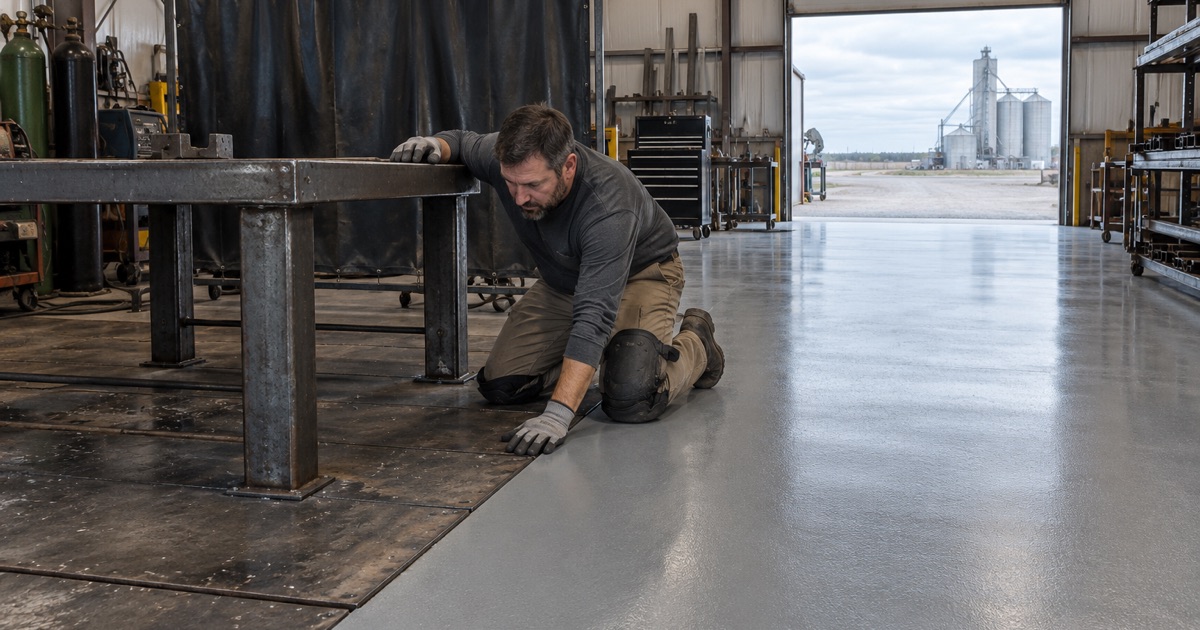
A zoned floor treats the shop as two surfaces under one plan. Weld and grinding stations keep bare concrete, a penetrating seal or a steel plate, while benches, aisles, wash areas and storage get the full coating system. The line between them is drawn on purpose during the walkthrough, not wherever the roller happened to run out.
What stays bare, sealed or plated
At the welding table, bare concrete or concrete treated with a lithium silicate densifier is usually the right surface. The densifier hardens the top of the slab and cuts dusting without leaving a resin film to burn. Many welders also lay steel sheet or fire-resistant board under cutting and grinding, or roll the table outside for heavy work.
A loose steel plate under the welding table is our first suggestion in a home garage. It catches spatter and slag, slides aside when the car comes back in, and scrapes clean in a minute. In a fabrication bay, the bare or plated zone is usually sized around the guards and welding screens the shop already uses.
What gets the full coating system
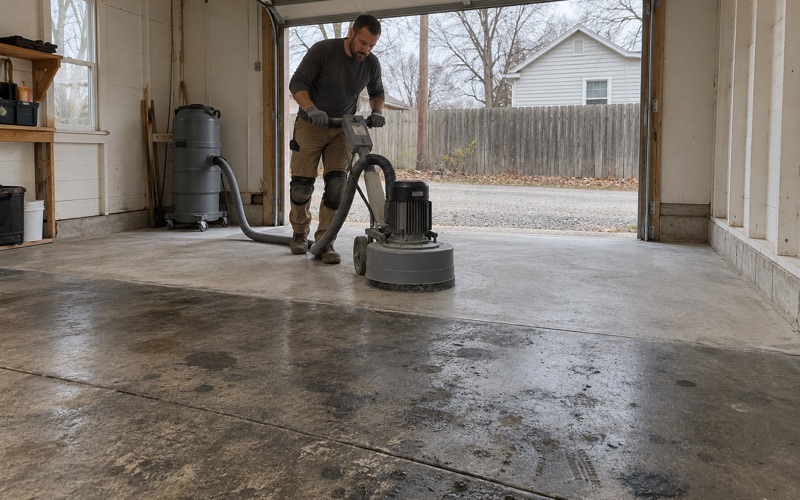
Away from the hot zone, the floor works like any hard-use shop floor. We open the slab with a diamond grinder or shot blaster, never an acid etch, to reach a measured ICRI concrete surface profile. A moisture test comes first and is written into the scope before the price is final, using ASTM F2170 in-situ relative humidity probes or ASTM F1869 testing.
Benches and aisles typically get a 100% solids epoxy base with a quartz aggregate broadcast and a polyaspartic topcoat, which stands up to dropped parts, cart wheels and solvent wipe-downs. The slip-resistant texture comes from the broadcast and topcoat we specify, and that choice is written into the proposal rather than promised as a slogan.
Mapping the slab before anything is coated
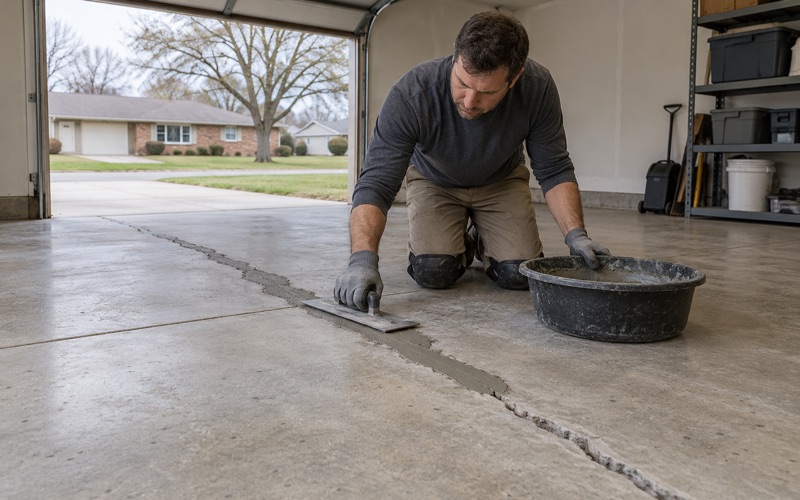
Slabs in town vary widely in age; 812 of the city’s 3,229 housing units date to 1939 or earlier, and many garages behind those houses were poured decades after the house went up. We map cracks, spalls, joints and any old coating first, and we say plainly when a slab needs repair or replacement before it should be coated.
Grinding and shot blasting raise fine concrete dust, so we capture it at the machine with a vacuum instead of rinsing it toward a floor drain. That matters more in a shop with a wash area, where the drain already serves the parts bay and does not need a load of concrete fines on top of it.
Keeping the Coated Zone Clean and the Line Visible
A zoned floor only works when everyone in the shop can see where the zones are and keeps hot work on its own side. That is a housekeeping job as much as a coating job, and we plan for it in the layout instead of leaving it to good intentions after the crew has packed up.
Marking the boundary
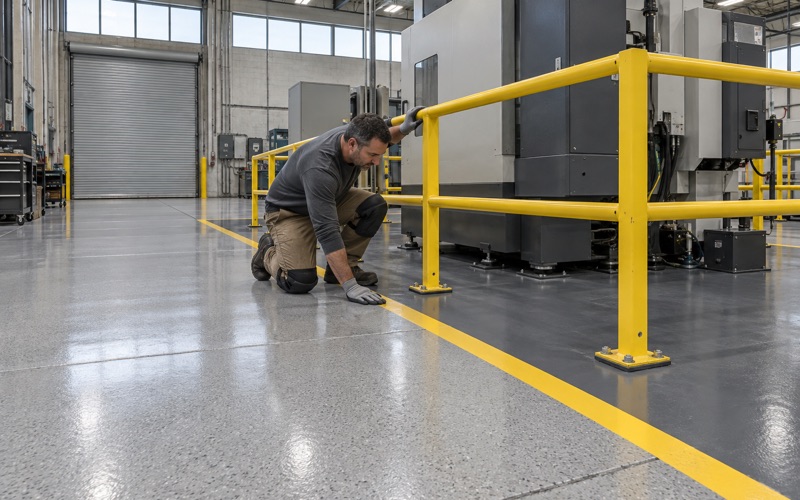
We end the coating at a clean, ground edge rather than a feathered taper, so the line between bare and coated concrete is crisp and does not lift at the margin. A contrasting color band or a painted safety stripe along that edge tells a new employee or a visiting neighbor where grinding is allowed and where it is not.
In a larger shop the boundary often follows the welding screens. Where a station moves, a steel plate can extend the hot zone for a week without recoating anything. The point is that the coated area is defined by how the shop works, so the floor does not get scorched the first time a project runs long or spills past its usual corner.
Sweeping slag before it travels
Slag and spatter tracked onto the coating on boot soles scratch the topcoat over time. A broom and a magnetic sweeper run at the end of each hot-work session keep metal fines inside the bare zone. The 1910.252 call to keep the floor around a weld swept clean happens to protect the coated aisle next to it as well.
The coated zone itself cleans with a neutral cleaner and a squeegee. We leave a written care sheet with the cure schedule, the cleaners to skip on a fresh topcoat and a reminder that burns from hot work are not something any topcoat is built to absorb, which is the whole reason the floor is zoned.
Cure timing in a working shop
Cure schedules follow slab temperature and the dew point spread at the slab surface, not the calendar. An unheated shop or garage in a central Iowa winter is told to wait, because resin on a cold, damp slab can blush and lose adhesion. For businesses, we phase the work around shifts, with overnight and weekend windows so production keeps moving.
What a coating warranty leaves out is explained before the job is sold, and moisture vapor transmission is the first exclusion we name. Knowing those limits up front, along with where the hot zone ends, is what lets a shop owner in Nevada judge the finished floor against the quote instead of against a sales pitch.
- 20+ Years on Iowa Concrete
- Moisture Tested in Writing
- Free Estimates