Ames Epoxy Flooring installs metallic epoxy floors in Ames, IA and nearby, serving surrounding cities including Polk City, Ankeny, Huxley, Boone and Nevada. A metallic floor uses fine mica pigments in a clear epoxy that is worked while wet into swirls, veins and pools of color, producing a surface with real depth. It is the most decorative system we install and also the one that depends most on the hands of the person laying it.
Because the resin flows into its final pattern, a metallic floor shows everything under it. Dips in the slab become puddles of color, a ridge from an old repair can catch the light, and dust in the room settles into the wet coat. That is why our metallic work starts with a diamond grinder, a moisture test and a careful look at how flat the floor really is, before we talk about colors at all.
With more than twenty years of coating central Iowa concrete, we know where these floors succeed and where they struggle. The written proposal lists the product line, the coats, the finished thickness and the UV-stable topcoat, along with the warranty exclusions, so you know exactly what you are getting before the first pigment is mixed.
How a Metallic Epoxy Floor Is Built
Grinding and Flattening the Slab
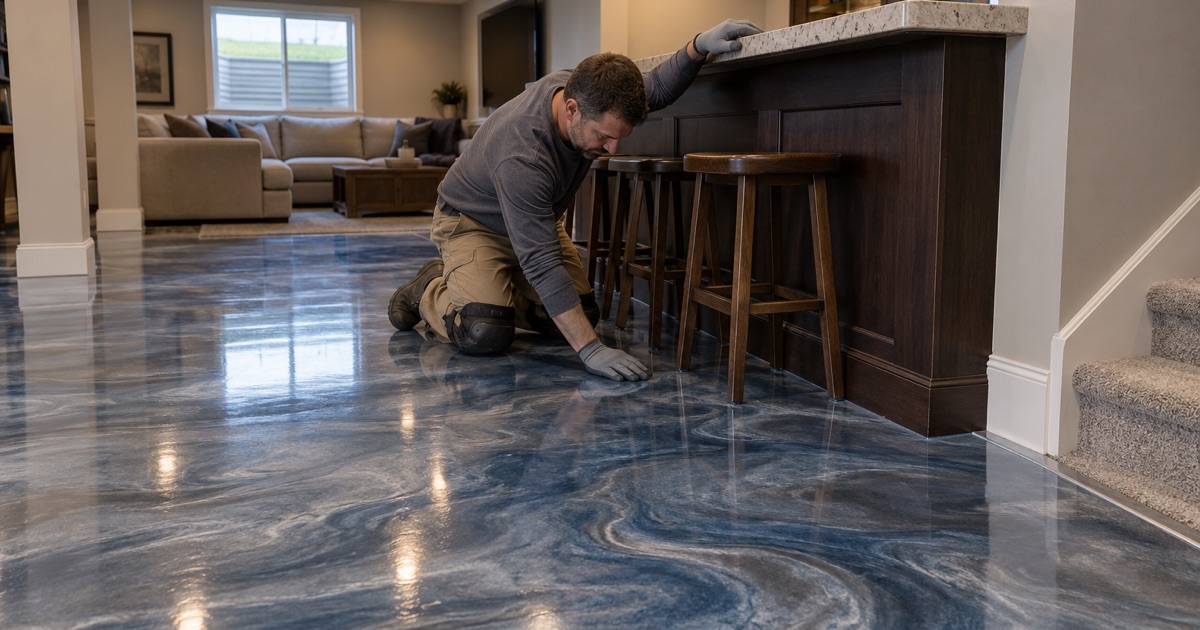
Every metallic floor begins with diamond grinding to an ICRI concrete surface profile, never an acid etch. On a metallic job, grinding also has a second purpose: knocking down high spots, ridges and trowel marks that a flake floor would hide but a flowing clear resin would show. Low areas can be filled with a leveling layer so the metallic coat sits at an even depth across the room.
Dust is captured at the grinder by a vacuum, and the room is cleaned thoroughly before any coating is mixed. On this system, a few stray particles can show as specks in the final surface, so the cleanup is part of the finish rather than an afterthought.
The Primer and Color Base Coat
A primer or tinted base coat goes down first, sealing the concrete and setting the background tone that the metallic layer reflects. A dark base tends to deepen the colors above it, while a lighter base makes pearlescent shades brighter. The choice is made with sample boards rather than guesswork.
Where the slab moisture readings call for it, a moisture-mitigation primer goes under the base coat. A metallic floor with a bubble or blister in the middle of the room is impossible to patch invisibly, which makes the moisture test even more important than usual.
Working the Metallic Layer
The metallic epoxy is poured and spread, then moved with rollers, brushes, sprayers or solvent mists to create movement in the pigment. Some clients want gentle, cloudy marbling; others prefer bold veining or a lava-like flow. The technique is chosen on the sample boards and practiced before it reaches your floor.
The working time is limited, so the crew sizes each pour to what it can manipulate before the resin starts to set. Large rooms are planned so the edges of one pour blend into the next without a visible seam.
UV-Stable Topcoat
Standard epoxy ambers in sunlight, which can turn a cool silver or blue metallic toward a yellow cast over time. We seal metallic floors with a UV-stable polyaspartic or aliphatic polyurethane topcoat that protects the color and adds abrasion resistance. On any floor that sees daylight, this topcoat is part of the system rather than an upgrade.
The topcoat also sets the sheen and, where needed, the slip resistance. A high gloss shows the depth of the metallic layer best, while a satin finish or a fine texture additive gives better grip where water may reach the floor.
Where Metallic Floors Work Best
Finished Basements and Family Rooms
Finished basements are one of the most popular places for metallic epoxy, giving a lower level a polished, finished look without carpet or wood. Before we recommend it, the basement is read for past water, the sump and floor drain are checked, and the slab is tested, because a metallic finish shows a moisture failure more than any other coating.
Low-odor products are available for basements with limited airflow. They are a comfort and re-entry choice, and Iowa law does not require them for a home.
Showrooms, Offices and Retail Spaces
Showrooms, salons, offices and retail spaces use metallic floors to make a strong first impression, and the seamless surface is easy to clean. Logos, borders and saw-cut lines can be built into the design to fit a brand. Work in a commercial space is scheduled after hours or over a weekend so customers never see the crew.
In busy commercial entries, the topcoat takes the wear of daily foot traffic, grit and winter salt. We plan walk-off matting and a maintenance routine so the finish stays clear rather than hazing in the traffic lanes.
Kitchens, Bars and Home Studios
Metallic floors also suit residential kitchens, home bars and studios where the floor is part of the design. The seamless surface handles spills well, and the depth of the finish reads well under pendant and track lighting.
In wet areas, we lower the sheen or add a fine texture to the topcoat for grip. Felt pads under chairs and stools keep the topcoat from scratching in the spots that see the most movement.
Planning Color, Pattern and Finish
Choosing Colors and Effects
Metallic pigments come in silvers, golds, coppers, blues, grays and many blends, and they can be layered for a multi-tone effect. The same pigment can look entirely different depending on the base color, the technique and the light in the room. We make sample boards in your chosen colors and look at them in place.
Most clients narrow the choice to two or three combinations before deciding. The pattern on your floor will be unique, so the samples show direction rather than an exact copy of the finished surface.
Lighting and How the Floor Reads
The way light hits a metallic floor changes how it looks from one corner of the room to another. Windows, recessed fixtures and garage-style overhead lights all bring out different parts of the pattern, and raking light from a low window shows the depth most dramatically.
We consider the lighting during the design so the floor’s movement works with the room instead of against it. Lighter, pearlescent palettes tend to brighten a basement, while darker tones add drama in a showroom.
Slab Problems a Metallic Finish Reveals
Old Coatings, Paint and Adhesive
A metallic floor cannot go over paint, sealer, an old coating or tile glue, because any of those can release and take the new finish with it. All of it is ground off down to sound concrete, and older black tile mastic may need asbestos testing before anyone grinds it. We raise that before quoting, and the removal is priced as its own line.
Residue that is left behind does not just weaken the bond. On a clear, flowing finish it can also show through as a shadow or a change in how the pigment settles, which is why we inspect the ground slab closely before the primer goes down.
Cracks, Joints and Repairs
Cracks and spalls are filled and ground flush, but the resin can settle slightly differently over a repair, leaving a faint line in the pattern. Control joints can be filled for a seamless look or kept open as clean lines, and we discuss which suits the design before the install.
Where a crack is still moving, a rigid fill will reopen and the line will return through the finish. If cracking is widespread or the slab has heaved, we tell you it needs repair or replacement before a decorative floor makes sense.
Moisture Under a Decorative Floor
Moisture coming up through a slab shows as bubbles, blisters or cloudy patches, and on a metallic floor those defects sit in plain view. Every slab is moisture tested before the price is final, whatever the age of the building, and the result decides whether a mitigation primer belongs in the system.
The warranty conversation starts with moisture too, since nearly every coating warranty excludes damage from vapor transmission and hydrostatic pressure. We explain that before the job is sold so the decision is made with the full picture.
- 20+ Years on Iowa Concrete
- Moisture Tested in Writing
- Free Estimates