Ames Epoxy Flooring has spent more than 20 years on epoxy flooring in Johnston and across central Iowa, and the floors we think hardest about are the ones where something has to roll. Carts, lifts and wheeled equipment all report every ridge in a slab, and the coating on top cannot hide a floor that was never flat to begin with.
Every slab we coat is opened with a diamond grinder or a shot blaster, never an acid etch, so the resin bonds to a real profile rather than a rinsed surface. A moisture test sits inside the written scope before the price is final, and the proposal names the product line, the number of coats and the finished thickness so the floor can be checked against the quote.
Most floors are judged by how they wear over years of traffic. A smaller group is judged by how flat they are on the day the work is handed over, and for those the coating is the lesser part of the job. This page covers that second group: what flatness means, how it is measured, and how a repaired slab is brought to it.
Television Studios on Corporate Drive in Johnston
Johnston is home to the Iowa PBS headquarters and main studio at 6450 Corporate Drive. The network’s own history page records that construction of new studios and an office building was completed in Johnston in 1986. We have no relationship with Iowa PBS, did no work there, and found nothing describing its floors, so we use the building only as the clearest local example of a room type.
That room type is the television studio, and it carries one of the strictest floor demands in commercial work. Office suites and warehouses tolerate a slab that drifts a little across a bay. A studio floor does not, because the equipment that crosses it is recording everything the floor does to it.
What a camera pedestal asks of a floor
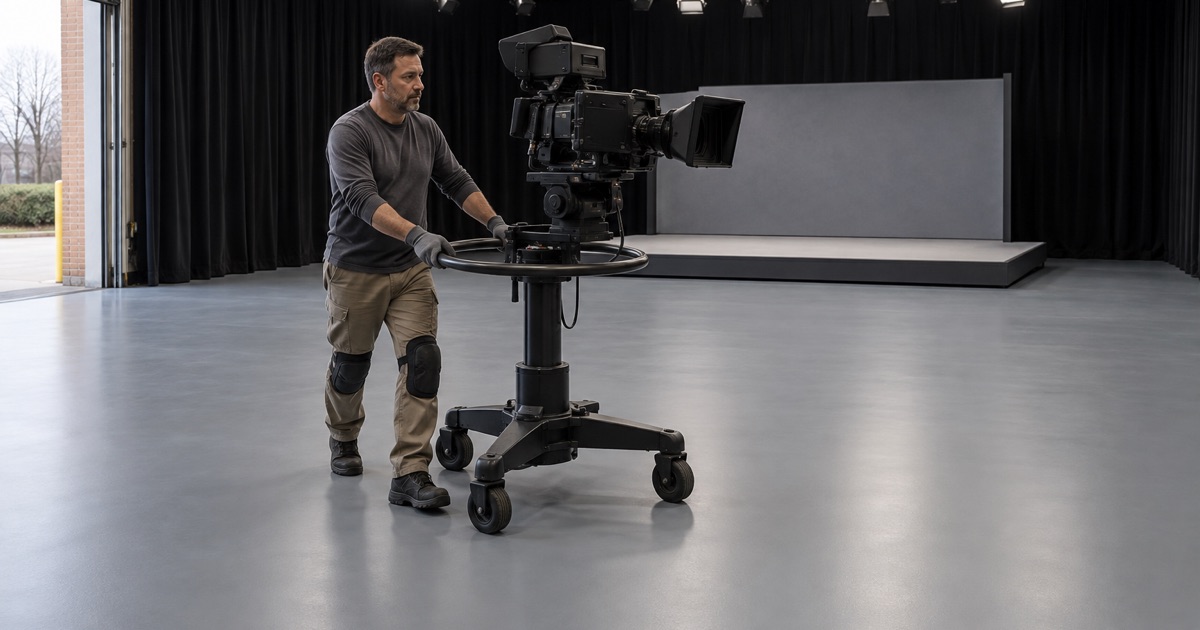
A camera pedestal is a wheeled base that carries a broadcast camera and lets an operator move it smoothly during a shot. The wheels sit close together and ride directly on the floor, so a small step, a raised crack edge or a dip at a patch passes straight up the column into the lens.
In HD and 4K production that movement shows. A resin maker’s case study from a refurbished UK studio put it plainly: a standard movement joint would have caused a camera pedestal to jump as it tracked over it. The floor there was rebuilt so the wheels could cross the whole room without a visible bump.
Why a studio floor is a flatness job first
A thin coating follows the slab beneath it. Roll a high-build epoxy over a floor with a hump and a hollow, and the result is a glossy hump and a glossy hollow. The shine can even make the defect easier to see under studio lighting.
That is why we treat this kind of floor as a concrete correction project that ends in a coating. The order of work, the materials and the inspection points all follow from the flatness target, and the color and finish are chosen last, once the slab is ready to carry them.
Looking for epoxy-flooring closer to Saylorville? See Epoxy-Flooring in Saylorville.
Flatness Measured With a Straightedge, Not by Eye
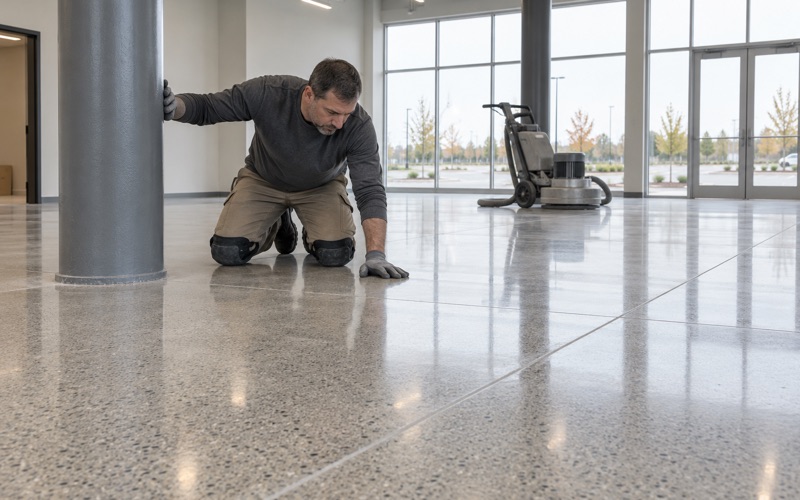
Nobody can judge flatness by walking a floor. A slab that looks level under fluorescent lights can still hold ridges and low spots that a wheel finds immediately. The working tool is a straightedge: a rigid, true bar laid across the surface, with the gap underneath measured at intervals.
The tolerance UK studio floors were built to
The UK case study set the refurbished studio floor at plus or minus 1 millimeter over a 3-meter straightedge, roughly 1/25 inch over 10 feet, and the installer described that figure as required for HD and 4K filming. It was tighter than the British Standard figure of 3 millimeters over a 2-meter straightedge that the same study cited.
These are manufacturer-reported numbers from UK projects, not a US code and not an Iowa rule. We cite them because they show what broadcast work has actually been built to. Any target for a Johnston floor gets agreed with the owner and written into the scope before grinding starts.
How we read a slab before quoting
On a floor where flatness matters, we map cracks, spalls, joints and old coatings first, then run a straightedge along the lanes where equipment travels. High spots, low spots and lips at patches all go onto a sketch of the room so the proposal describes the floor that actually exists.
Sometimes that survey says the slab needs repair, or in places replacement, before it should be coated at all. We say so in writing. A self-leveling layer can fill a shallow dip, but it cannot rescue a slab that is cracking for structural reasons or settling unevenly.
What a coating cannot promise
No coating guarantees a flatness number by itself. The result depends on the slab, the repair work, the pour and the cure together, and we build the scope around that chain rather than selling a figure as a product feature.
Warranty terms get the same honesty. Before a job is sold we explain what a coating warranty leaves out, and moisture is the first exclusion we name. Moisture vapor transmission and hydrostatic pressure from below can lift a resin floor no matter how flat it was poured.
Self-Leveling Resin Over a Patched Studio Slab
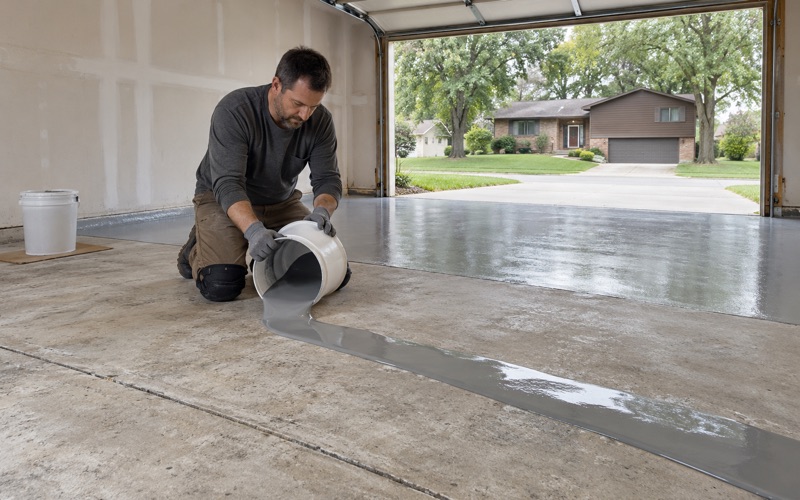
When a floor has to be flat and smooth, the usual answer is a self-smoothing epoxy poured over a repaired, profiled slab. The UK studio in the case study used exactly that build: crack-repair mortar first, then a self-smoothing epoxy body coat, across 788 square meters in five weeks.
Crack repair and grinding before the pour
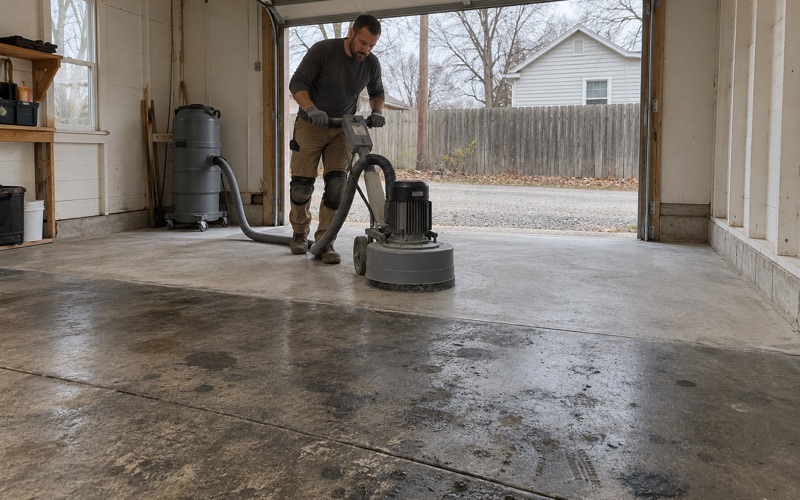
We start with diamond grinding to remove old coatings and open the surface to a measured concrete surface profile on the ICRI CSP scale. Grinding also takes down high spots the straightedge found, which is often the cheapest flatness gain on the whole job.
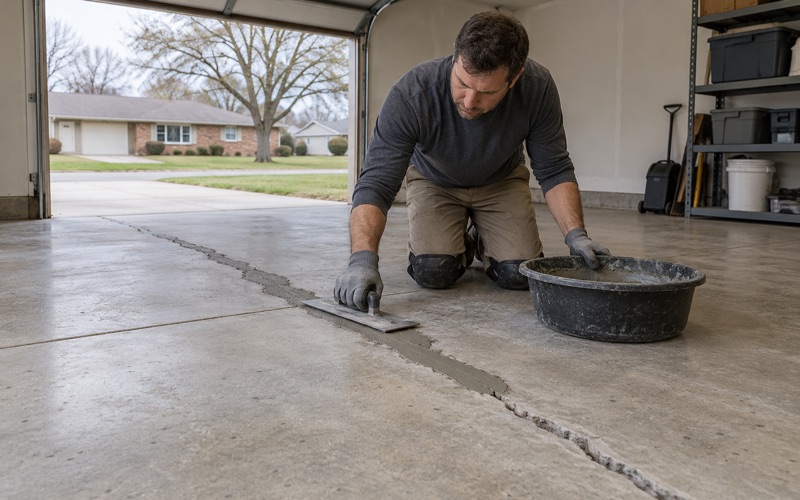
Cracks and spalls are then cut back and filled with a repair mortar, and each fill is ground flush before any resin goes down. A patch that sits proud by a hair becomes a ridge in the finished floor, so every repair gets its own straightedge check rather than an eyeball pass.
Moisture under the resin
A thick self-leveling layer is unforgiving of vapor coming up through the slab. We test with ASTM F2170 in-situ relative humidity probes, and ASTM F1869 calcium chloride kits where they fit, and the readings decide whether a moisture-mitigation primer goes down before the body coat.
This matters on older slabs in particular. A building finished decades ago may have no under-slab vapor retarder at all, and a room that has stayed dry under carpet or vinyl tile can behave differently once it is sealed under a continuous resin film.
Cure schedules and working windows
Cure follows slab temperature and the dew point spread at the slab surface, not the calendar. A pour into a cold room, or one with air near the dew point, can blush, cure slowly and leave a surface that has to be sanded and recoated before it can carry wheels.
Facilities that run on schedules get phased work. We plan overnight and weekend windows when a space cannot stop, and grinding dust is captured at the machine with a vacuum rather than swept or rinsed toward a floor drain. The same approach applies to research space elsewhere in Johnston, where Corteva’s Reid B and D lab renovations named new flooring in their 2022 scope.
Joints a Pedestal Has to Cross
Every slab has joints, and a flat floor still has to deal with them. In a studio, the question is narrow and practical: can a wheel roll across this line without a felt or visible bump? Everything we do at a joint in a pedestal lane answers that question.
Why a standard joint makes a pedestal jump
A conventional joint leaves a straight gap or a filled line square to the direction of travel. The wheel drops into it and climbs out of it in one sharp movement, and the camera records that jolt. The UK studio avoided this by installing a prefabricated waved joint, so the wheel never meets the whole edge at once.
We do not specify one joint product for every floor. What we do is identify which joints cross the lanes where equipment travels, and plan their treatment before the pour so the resin and the joint finish at the same height.
Treating sawcuts and cracks in travel lanes
Inactive sawcuts in a travel lane are cleaned out, filled with a rigid filler and ground flush, then carried under the self-leveling coat. Cracks that have stopped moving get the same treatment. A straightedge laid across each filled line is the test, not a glance from standing height.
Where a joint is still active, a rigid fill will crack again and print through the finish. We tell the owner that before the job starts, mark the line on the drawing, and agree how it will be handled, rather than promising a seamless floor the slab cannot support.
Texture and finish where wheels roll
Slip resistance is set by the broadcast and topcoat we specify, not by a slogan. A quartz broadcast that suits a wet shop floor would put grit under a pedestal wheel, so smooth lanes and textured zones are drawn separately on the plan and each finish is named in the proposal.
The topcoat is chosen the same way. A smooth, durable finish over the self-leveling body keeps wheels quiet and makes scuffs easy to clean, and the product line, the coat count and the finished thickness all appear in the written quote so the owner can hold the floor to it.
- 20+ Years on Iowa Concrete
- Moisture Tested in Writing
- Free Estimates