
Ames Epoxy Flooring installs epoxy garage floor systems in Ames, IA, serving surrounding cities including Nevada, Huxley, Boone, Polk City and Ankeny. After more than twenty years on central Iowa concrete, we build garage floors for the conditions they actually face here: brine dripping off tires from first snow to spring thaw, slabs that swing from frozen to warm, and cars parked on the surface every single day.
A garage coating fails for predictable reasons, and nearly all of them trace back to the concrete underneath rather than the resin on top. That is why our garage work starts with a diamond grinder, a moisture test and a map of every crack and spall, and why the color choice comes last. A good-looking floor over bad prep is a peeling floor waiting for its first warm tire.
The proposal you receive lists the product line, every coat and the finished thickness, along with what the warranty does not cover. You know exactly what is going down on your slab before the first bag of flake is opened.
Preparing a Garage Slab for Epoxy
Diamond Grinding Instead of Acid Etching
Acid etching leaves a thin, uneven profile and residue that has to be neutralized, and it does little for a slab that has been sealed or stained with oil. We grind every garage with diamond tooling to an ICRI concrete surface profile that resin can lock into, opening the pores evenly from wall to wall.
The grinder also removes the weak top layer of cement paste and any curing compound left from the pour. Dust is pulled into a vacuum at the machine, which keeps it out of the house and away from the floor drain.
Moisture Testing Every Garage Slab
Before we finalize a price, the slab is tested for moisture, starting with a plastic sheet test under ASTM D4263 and moving to calcium chloride or relative humidity testing when the result is close. Garage slabs are often poured without the vapor retarder a basement or living area gets, so a new house is no guarantee of a dry floor.
The readings decide whether a standard epoxy base is safe or a moisture-mitigation primer belongs under it. Either way, the result is written into your scope so the system matches the slab.
Crack, Spall and Joint Repair
Every crack, spall and popout is marked before pricing, then filled with a rigid repair material and ground flush with the surrounding floor. Control joints are either filled with a semi-rigid filler or honored as clean lines in the finish, depending on how much the slab moves.
When the damage runs across most of the floor, or sections have heaved out of plane, coating will not hide it for long. We say so up front and recommend replacement of the affected slab rather than selling a coating that will crack along the same lines.
Garage Coating Systems We Install
Full-Broadcast Flake Epoxy
The most popular garage system is a 100% solids epoxy base with vinyl flake broadcast to full coverage, then a clear topcoat. The flake adds texture, hides grit and salt residue, and covers the small surface flaws that grinding reveals.
Chip size and blend are chosen from samples, and we lay sample boards in your garage light before ordering. A blend that looks warm in a showroom can read cooler under the LED fixtures most garages run.
Polyaspartic Topcoats Over Epoxy
A polyaspartic topcoat over an epoxy base pairs the deep bond and build of epoxy with a fast-curing, abrasion-resistant wear layer. Polyaspartic also resists the yellowing that sunlight causes in plain epoxy, which matters on the strip of floor nearest the door.
That combination is what we recommend for most attached garages that see daily parking. It holds up to the scuffing of sand, salt and tire turns where cars swing in from the driveway.
Solid Color and Quartz Garage Floors
A solid color garage floor, with or without a light texture additive, suits a workshop garage where you want to spot dropped bolts and see leaks right away. It costs less than a full flake system and still gets the same grinding and topcoat.
Where a garage doubles as a wash bay or gets regular water on the floor, a quartz broadcast gives a more aggressive grip. The texture level is set by the grit and the number of topcoats, and the proposal states which one you are getting.
Winter, Salt and the Iowa Garage
Calcium Chloride and Rock Salt on Garage Floors
The deicers spread on Iowa roads, calcium chloride and rock salt, ride into the garage on tires and wheel wells. On bare concrete that brine soaks in, freezes and thaws inside the surface and gradually scales the top layer away.
A coated garage floor keeps that brine on top, where a squeegee and a hose can send it out the door. The topcoats we specify are chosen for resistance to those deicer solutions rather than for gloss alone.
Freeze-Thaw Scaling Already in the Slab
Many garage slabs around Ames already show freeze-thaw scaling near the door, where snowmelt pools and refreezes. Scaled areas are ground back to sound concrete and rebuilt with a repair mortar or a thicker epoxy fill before the main system goes down.
Skipping that step leaves weak concrete under the coating, and the coating comes off with it. Rebuilding the scaled zone is listed as its own line on the proposal.
Cure Temperatures and Dew Point
Resins cure by chemical reaction, and that reaction slows sharply on a cold slab. If the slab surface sits too close to the dew point, moisture condenses on it and leaves amine blush, a waxy film that weakens the bond between coats.
We measure slab temperature and dew point spread before each coat. An unheated garage in the middle of a central Iowa winter usually waits for spring, unless temporary heat can keep the slab steady through the full cure.
Hot Tire Pickup on Garage Coatings
A tire that has just come off a warm highway softens whatever it parks on, and as it cools it grips the surface. On a thin coating over a poorly prepared slab, the tire lifts the coating when the car backs out, leaving two bare stripes where the wheels sit.
The fix is not a special product so much as the full system: a ground profile, a 100% solids base built to real thickness and a hard topcoat. A floor built that way resists the pull of a hot tire, and the proposal states the thickness you are paying for.
Our Step-by-Step Epoxy Garage Floor Process
Step 1: Slab Walk and Moisture Test
We measure the garage, map cracks and old coatings, and run the moisture test. The proposal follows with the product line, coats, finished thickness and warranty exclusions written out, so you can compare it line for line against any other quote you collect. This is also when we talk through flake blends, sheen and texture, and when we tell you which items need to come off the floor before install day.
Step 2: Grinding and Repair
The slab is diamond ground edge to edge, with dust captured at the machine and the entry door to the house sealed off. Cracks, spalls, scaled areas and joints are filled and ground flush, so the repairs sit level with the rest of the floor rather than telegraphing through the finish.
Step 3: Base Coat and Broadcast
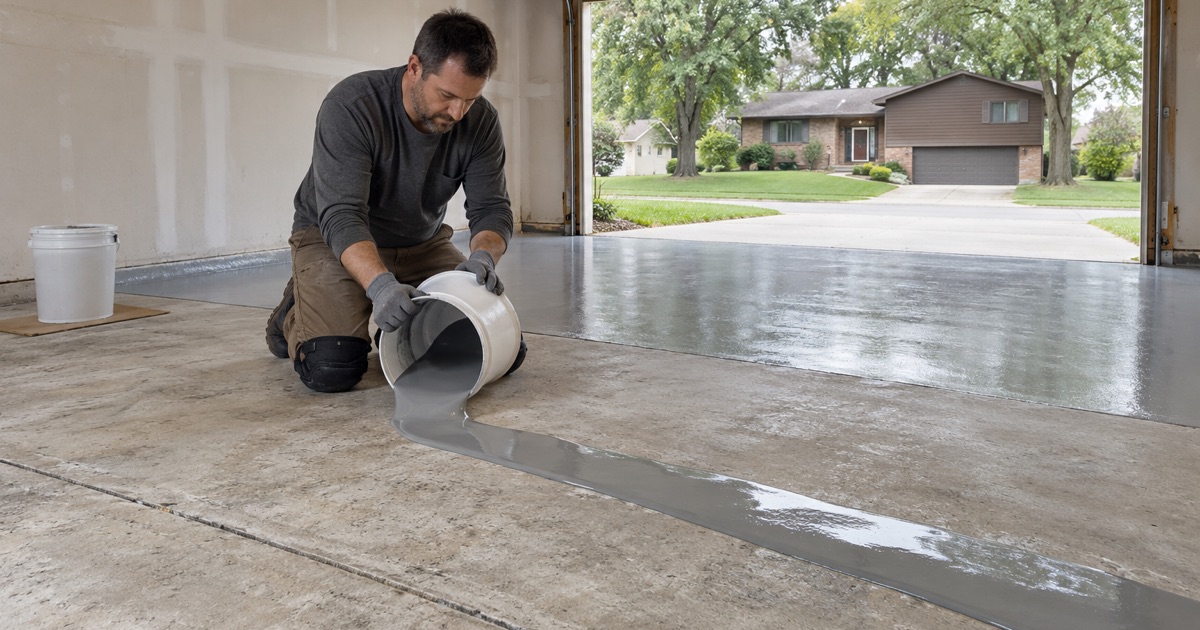
The epoxy base is rolled out at the thickness named in the proposal and, on a flake or quartz system, broadcast while it is still wet. Once it cures, loose material is scraped off and the whole floor is vacuumed, leaving a firm, even texture ready for the clear coat.
Step 4: Topcoat and Cure
The clear topcoat goes on over the broadcast and cures to the schedule set by slab temperature, not a fixed number of hours. We give you the dates for foot traffic and for parking before we leave, along with care notes for the first winter on the new floor.
- 20+ Years on Iowa Concrete
- Moisture Tested in Writing
- Free Estimates