
Ames Epoxy Flooring installs ESD flooring in Ames, IA, serving surrounding cities including Ankeny, Huxley, Nevada, Boone and Polk City. Electrostatic discharge, the small spark that jumps when a charged person touches an object, can damage sensitive electronics, disrupt instruments in a lab and create a hazard where flammable vapors are present. An ESD floor gives that charge a controlled path to ground, so it drains away before it can do harm.
These floors are more technical than any other coating we install. They depend on a grounding layout, a conductive primer, a coating formulated to sit in a specific resistance range, and testing once the floor has cured. With more than twenty years of preparing and coating central Iowa concrete, we approach ESD work the same way we approach every floor: the slab is ground, moisture tested and mapped first, because an ESD system that delaminates no longer grounds anything.
How an ESD Floor Works
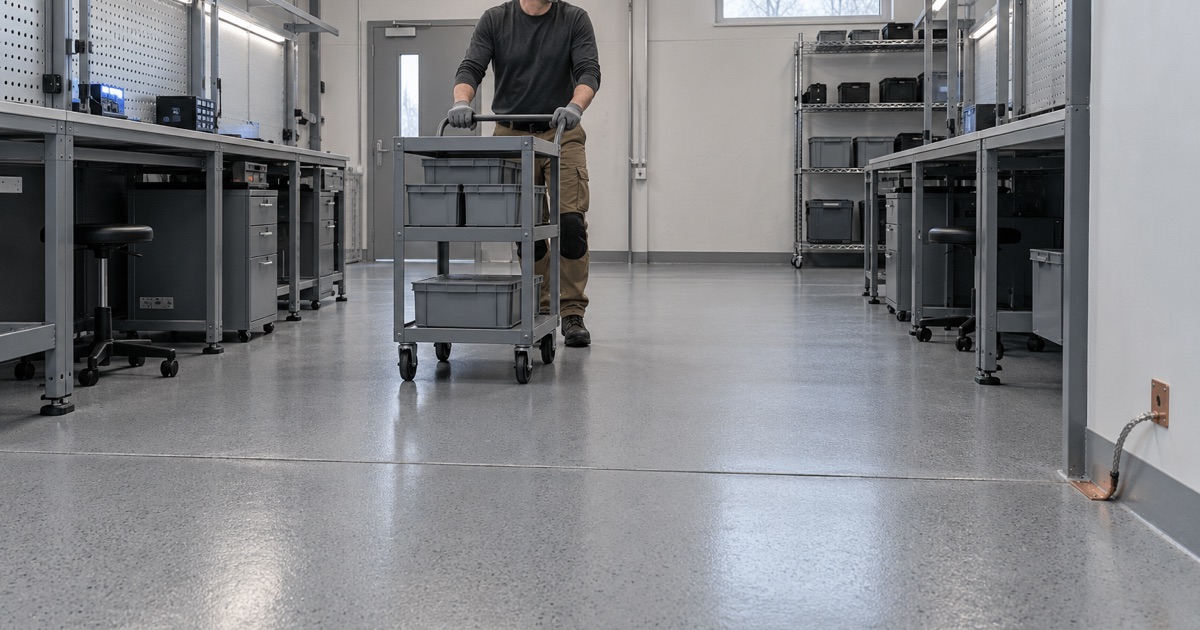
Static-Dissipative and Conductive Floors
ESD floors fall into two broad groups. Conductive floors have lower resistance and drain charge quickly; static-dissipative floors have higher resistance and drain it more slowly and in a more controlled way. The resistance range a floor must meet is set by the facility’s ESD program, commonly built around the ANSI/ESD S20.20 standard, and by the devices being handled.
We confirm the target range with you or your specification before choosing the system. Getting that decision right at the start is far easier than trying to adjust a floor after it is installed.
The Grounding Layer
Before any coating goes down, copper grounding strips are laid on the prepared slab and connected to the building’s electrical ground at planned points. A conductive primer then covers the slab and the strips, creating a continuous layer that carries charge to those ground connections.
The number and placement of the ground points depend on the room’s size and layout. We plan them with you and your electrician so they tie into the building ground correctly.
The ESD Coating
The finish coat is an epoxy formulated with conductive materials so that it sits within the target resistance range once cured. Film thickness matters: too thin and the floor may not perform consistently, too thick and resistance can rise outside the range.
The proposal names the product line, each coat and the finished thickness. The coating is also built to handle the foot traffic, carts and rolling equipment of a working floor, not just to meet an electrical number.
Where ESD Flooring Is Used
Electronics Assembly and Repair
Any space where circuit boards, components or devices are assembled, repaired or tested can benefit from an ESD floor. Even small discharges that a person cannot feel can damage or weaken sensitive components, and the damage may not show until a part fails later.
In these spaces, the floor works alongside ESD footwear or heel grounders, grounded workbenches and wrist straps. The floor provides the path to ground; the rest of the program makes sure people are connected to it.
Labs, Server Rooms and Control Rooms
Research labs, server rooms, data closets and control rooms often use static-dissipative floors to protect instruments and equipment. In those rooms, the floor is usually specified alongside grounded racks and work surfaces rather than chosen on its own.
Lab work is phased around research schedules, with overnight and weekend windows when work cannot stop. Rooms with sensitive equipment are sealed off during grinding, and dust is captured at the machine.
Areas With Flammable Vapors or Powders
In spaces where flammable solvents, vapors or fine powders are handled, a static spark can be a fire or explosion risk. Conductive flooring can be part of the controls in those areas.
Requirements for these spaces come from the facility’s safety program and the applicable codes. We follow the specification provided and document the floor’s resistance readings for your records.
Prep, Testing and Care
Slab Preparation and Moisture
ESD systems are applied over a slab that has been diamond ground or shot blasted to an ICRI concrete surface profile and tested for moisture. Moisture can interfere with both the bond and the electrical performance of the floor.
Where moisture readings are high, a moisture-mitigation primer compatible with the ESD system is added. Cracks and joints are repaired and ground flush so the conductive layer is continuous.
Resistance Testing at Handover
Once the floor has cured, it is tested with a resistance meter and electrodes at points across the room, using the test method your specification names, such as ANSI/ESD STM7.1. We record the readings so you have a baseline for your facility’s periodic checks.
If any area reads outside the target, it is investigated and corrected before the floor is handed over. The test results are part of the job record.
Cleaning an ESD Floor
Regular floor waxes, polishes and some cleaners leave an insulating film that can push an ESD floor outside its resistance range. We provide care guidance based on the coating maker’s recommendations, including which cleaners to use and which to avoid.
Periodic retesting, especially after a change in cleaning products or a long period of heavy use, keeps the floor working as intended. The baseline readings recorded at handover give your team something to compare those later tests against.
Planning an ESD Floor Project
Footwear, Carts and Chairs
An ESD floor only protects what is connected to it. People need ESD footwear or heel grounders, and carts, chairs and mobile equipment need conductive casters or drag chains so they do not build up charge as they roll. Standard rubber wheels and ordinary shoes can insulate a person or a cart from the floor entirely.
We talk through what moves across the floor during the planning stage. That conversation often turns up a cart or chair that needs new casters before the room can rely on the floor.
Scheduling Around Sensitive Equipment
Most ESD floors go into rooms that are already full of equipment or are part of a working facility. Equipment has to be moved out or protected, and dust from grinding has to be kept away from anything sensitive in neighboring spaces.
We plan the work in phases where needed, with overnight and weekend windows for areas that cannot be down during the workday. The proposal sets out the schedule, the cure time before equipment returns, and the date of the final resistance testing.
- 20+ Years on Iowa Concrete
- Moisture Tested in Writing
- Free Estimates