
Ames Epoxy Flooring provides concrete grinding and shot blasting in Ames, IA, serving surrounding cities including Boone, Nevada, Ankeny, Huxley and Polk City. Grinding is the step that decides whether a floor coating holds or peels. It removes the weak top layer of a slab, strips old coatings and contaminants, and leaves an open, consistent surface for a new coating, overlay or polish to bond to.
Every floor we coat is ground or shot blasted first, and we never use an acid etch in its place. With more than twenty years of preparing central Iowa concrete, we have seen the difference prep makes over and over: the same product that fails on an etched slab will often hold for years on one that was properly ground. We also grind slabs for other trades and owners who need a floor opened, flattened or stripped.
Surface Profile and Why It Matters
ICRI Concrete Surface Profile
The International Concrete Repair Institute publishes a scale of concrete surface profiles, CSP 1 through CSP 10, from nearly smooth to heavily textured. Each coating system calls for a range on that scale, with thin coatings needing a finer profile and thick overlays needing a rougher one.
We match the tooling and the number of passes to the profile your coating requires, then check the result against reference chips before priming. A profile that is too smooth gives the coating nothing to grip; one that is too rough wastes material and can telegraph through a thin finish.
Removing Laitance and Curing Compounds
Freshly poured concrete often finishes with laitance, a weak, powdery layer of cement paste at the surface, and many slabs are sprayed with a curing compound or sealer. Both prevent a coating from bonding to the sound concrete beneath them.
Grinding cuts through those layers in a way that etching cannot. On newer homes and commercial slabs, this is often the main reason a do-it-yourself coating failed, even though the floor looked clean.
Confirming the Bond
On commercial projects, or where a specification requires it, bond strength can be confirmed by pull-off adhesion testing under ASTM D4541. A small fixture is bonded to a test area and pulled until it lets go, showing whether the failure happened in the concrete, the coating or the bond between them.
The test is a useful check that the prep did its job before the full system goes down. For most residential jobs, careful grinding and a visual check of the profile are enough.
Grinding Equipment and Methods
Diamond Grinding
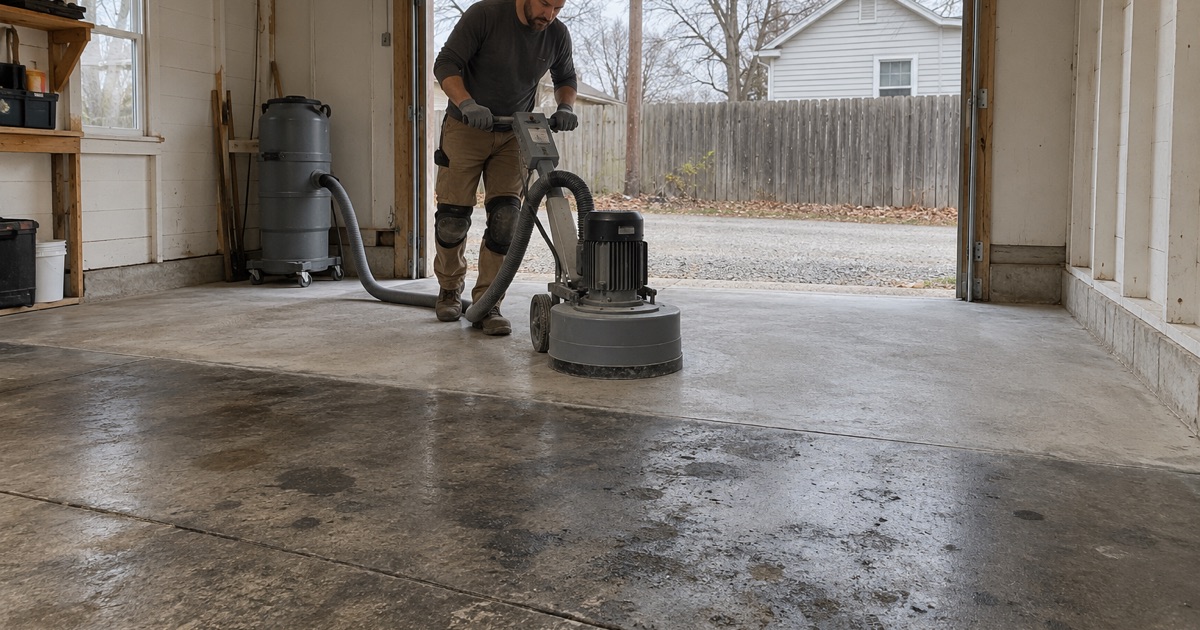
Diamond grinders use rotating heads fitted with metal-bond or resin-bond diamond segments. Coarse segments strip coatings and cut aggressively, while finer ones refine the surface and remove scratches. Edge grinders and hand tools reach along walls, around posts and into corners that a large machine cannot.
Diamond grinding gives the most control over flatness and profile, which matters for thin coatings, metallic finishes and polished concrete. It is the method we use on most garages, basements and interior commercial spaces.
Shot Blasting
A shot blaster fires small steel shot at the surface, which knocks off contaminants and leaves a uniform textured profile, then recovers the shot for reuse. It covers large, open areas quickly and creates the rougher profile that thicker coatings and overlays need.
Shot blasting suits warehouses, plants and large commercial floors. Edges and corners are still finished with grinders, since a blaster cannot reach right up to a wall.
Dust Captured at the Machine
Every grinder and blaster we run is connected to an industrial vacuum that collects dust where it is created. That keeps concrete dust out of the rest of the house or building, away from stock and equipment, and out of the air the crew breathes.
We never rinse grinding dust toward a floor drain or storm inlet. Concrete fines that wash into Ames storm sewers end up in local streams, so the dust is bagged and hauled away instead.
Stripping Old Coatings and Residues
Paint, Epoxy and Sealers
Peeling paint, failed epoxy and old sealers have to come off completely before a new coating can bond to the slab. Grinding removes them along with the top skin of concrete beneath, so the new system is not relying on whatever bond the old one still has.
Some coatings are thick or flexible enough to gum up diamond tooling and need special segments or extra passes. We look at the floor and test a small area before pricing removal.
Tile Adhesive and Mastic
Older floors often carry black tile mastic or carpet adhesive left behind when a covering was pulled up. Those adhesives have to be removed down to clean concrete, and some older black mastics contain asbestos, so they may need to be tested before grinding.
We raise that question before quoting rather than discovering it mid-job. Removal of adhesives is listed on the proposal as its own line.
Oil-Soaked Concrete
Garage and shop slabs that have absorbed years of oil, grease and hydraulic fluid can resist a coating even after grinding, because the oil keeps wicking back to the surface. Heavily soaked areas may need degreasing, extra grinding or a specialty primer to bond.
We identify those spots during the slab walk and tell you what they need. In some shops, the most contaminated areas are better left uncoated or treated differently from the rest of the floor.
Flattening and Correcting the Surface
High Spots, Lips and Trowel Marks
Grinding can take down high spots, lipped joints and trowel ridges that would otherwise show through a coating or catch a pallet jack wheel. It is especially important under metallic and polished finishes, where any unevenness becomes part of the look.
For most coatings, the goal is a uniformly profiled surface rather than a perfectly flat one. Where flatness matters more, we discuss it during the slab walk so the scope reflects it.
When Grinding Is Not Enough
A slab that has heaved, settled out of plane or broken into pieces will not be fixed by grinding. Removing enough concrete to correct major movement weakens the slab, and the movement usually continues under the new finish.
In those cases, we say plainly that the slab needs repair or replacement before it is coated or polished. Telling you that up front costs less than a coating that cracks along the same lines within a season.
- 20+ Years on Iowa Concrete
- Moisture Tested in Writing
- Free Estimates