Ames Epoxy Flooring handles epoxy flooring in Clive for owners who need a floor that does a job, not just one that looks finished, and we bring more than 20 years of slab preparation to every project. Most of our work here starts with one question: what will roll, walk or be bolted to this floor every day? The answer decides the system, the texture and the schedule.
That question matters most in rooms where people are recovering their balance. Therapy spaces, clinic corridors and accessible living areas ask a coating to stay put under a walker tip, give a wheelchair an easy push and still offer grip when a shoe meets a damp spot. Those are properties we can describe, so we write them into the proposal rather than leaving them to a brochure.
Every slab we coat is opened mechanically, tested for moisture before the price is final and mapped for cracks and old coatings first. The proposal names the product line, the coat count and the finished thickness, so a facility manager or homeowner can hold the finished floor up against the quote and see whether it matches.
A Rehabilitation Hospital on Campus Drive
Clive is a city of 18,601 people at the 2020 Census, part of the Des Moines metropolitan area and split between Dallas and Polk counties. Within it, a cluster of health buildings has grown up around NW 114th Street and Campus Drive, and one of them shapes how we think about floors in this city more than any other building does.
What opened in June 2018
MercyOne Clive Rehabilitation Hospital, at 1401 Campus Drive, opened in June 2018 with 50 beds in 58,000 square feet, replacing a 14-bed rehab unit at Mercy’s main campus. Reporting at the opening described a therapy gym with current equipment and an apartment-style space where patients practice daily tasks in a setting that mimics home.
We have no relationship with MercyOne or its partners, we did no work there, and we have not seen what floors the building has. We name it because it makes a working requirement concrete: in rooms like these, the floor carries people relearning to walk, and that changes what a good floor has to do.
Who moves across a floor like this
In a rehabilitation setting the traffic is unusual. Patients move with walkers and canes, others wheel themselves, and therapists guide steps across open floor. Every one of those loads lands on a small contact point, such as a rubber cane tip, a caster or a walker glide, and each depends on the surface behaving the same way from one end of the room to the other.
The same holds for smaller outpatient therapy rooms, physician offices and assisted living common areas around Clive. Whatever the building, we start by asking the owner how people move through the space, because that answer chooses the broadcast, the topcoat and the cure plan before anyone talks about color.
Looking for epoxy-flooring closer to Nevada? See Epoxy-Flooring in Nevada.
Stable, Firm and Slip Resistant: Three Words That Set the Spec
The 2010 ADA Standards for Accessible Design put it plainly in section 302.1: floor and ground surfaces shall be stable, firm, and slip resistant. The advisory notes define each word, and each one maps to a decision we make on the slab. A coating by itself does not make a floor ADA compliant, but it can be built to serve all three properties.
Stable
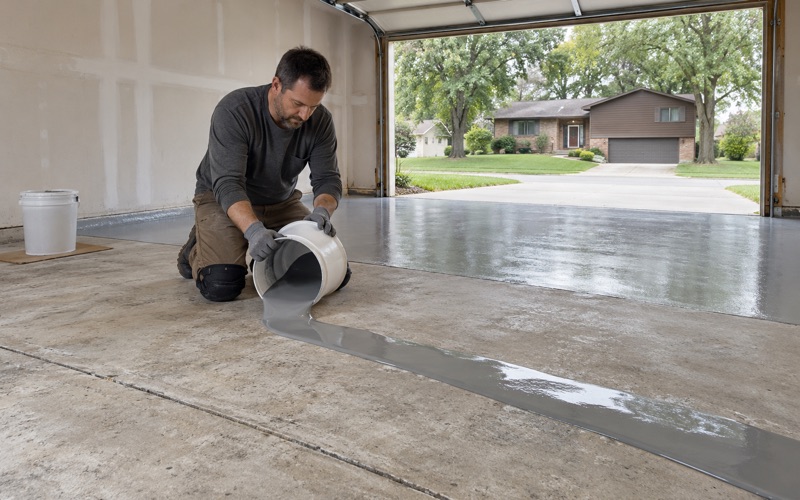
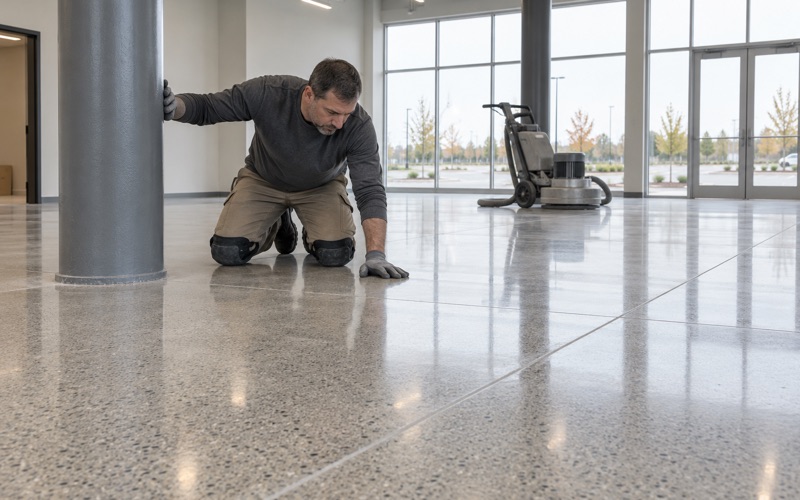
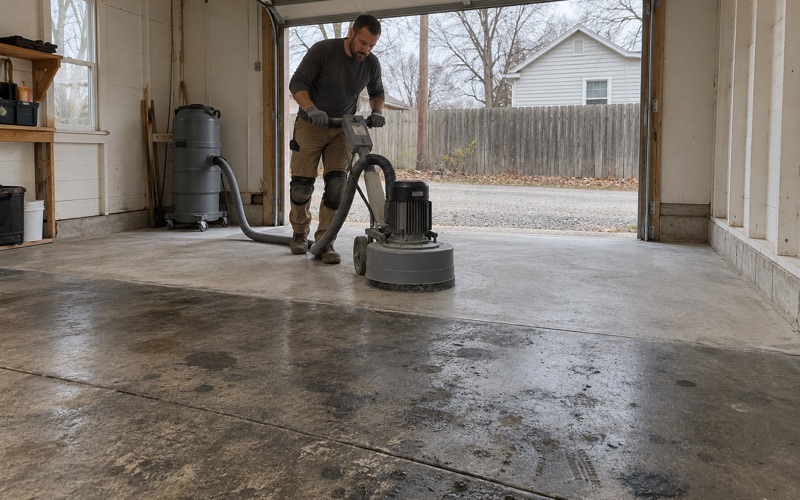
The advisory describes a stable surface as one that remains unchanged by contaminants or applied force. For a resinous floor, that starts underneath. A coating bonded to a weak, dusty or damp slab can lift or blister later, so we open every slab with a diamond grinder or shot blaster, never an acid etch, to a measured ICRI concrete surface profile.
Moisture is the other half of stability. We run ASTM F2170 in-situ relative humidity probes or ASTM F1869 calcium chloride tests as part of the written scope, and where the readings call for it we specify a moisture-mitigation primer. Moisture is also the first exclusion we name when we explain what the coating warranty does not cover.
Firm
A firm surface, in the advisory’s words, resists deformation by indentations or particles moving on its surface. A 100% solids epoxy body coat at a stated thickness gives a hard, continuous layer that a walker leg or a wheel does not sink into. Loose aggregate is the opposite of firm, which is why every broadcast is locked down under a sealing topcoat.
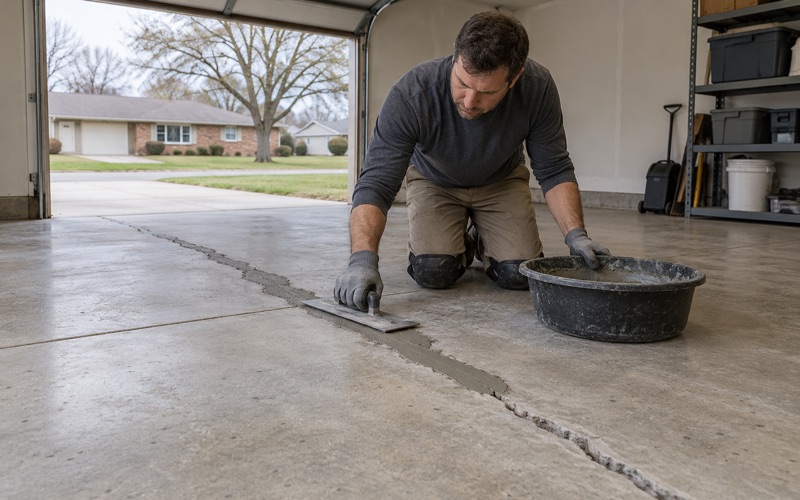
Before any of that, we map cracks, spalls, joints and old coatings. A cracked or spalled slab is repaired first, and when a slab is too far gone we say so and recommend replacement rather than coating over it. A firm floor cannot sit on a section of concrete that is already breaking apart underneath it.
Slip resistant
The advisory defines a slip-resistant surface as one that provides sufficient frictional counterforce to the forces exerted in walking. We specify that texture by name: a quartz aggregate or fine vinyl flake broadcast set into the body coat and held by a polyaspartic or urethane topcoat at a stated rate. No surface prevents falls, and we never sell one that way.
Texture is a balance. A coarse grit helps a shoe on a wet spot, but it makes a floor harder to mop and rougher under a hand that braces against it. Where we can, we sample two or three textures on the actual slab, so the owner chooses on feel rather than on a catalog photo.
Rolling Resistance for Wheelchairs and Walkers
The ADA advisory on carpet makes a point that applies to every floor choice. Carpet and permanently affixed mats increase the force needed to roll a wheelchair, and firmer carpet and backing reduce that resistance. Soft surfaces cost the person pushing, and a hard, seamless resinous floor sits at the other end of that scale.
Why soft and seamed surfaces add effort
A wheel on a soft surface sinks slightly and has to climb out of its own depression with every turn. That extra push adds up across a corridor or a therapy session, especially for someone still building strength. Seams, grout lines and loose mats add small interruptions, and a caster that catches can turn the chair or stop it short.
A coated floor removes most of that. The body coat runs continuous from wall to wall, joints are filled to the surface, and there are no grout lines for a small front caster to track. We still treat expansion joints as joints, because filling a joint that needs to move only sends the crack somewhere else.
Texture against rolling ease
Grip and rolling ease pull in different directions. The more aggressive the broadcast, the more a narrow wheel feels it. In areas that see mostly wheelchair and walker traffic we usually recommend a fine aggregate locked under a full topcoat, which keeps the surface firm and easy to roll while still giving a shoe something to hold.
In entry vestibules and wet zones where water arrives on shoes, a slightly heavier texture can earn its place. We mark those zones on the floor plan and adjust the broadcast room by room, so one finish is not forced to do every job in the building.
Checking the floor before it goes into service
A floor that will carry wheelchairs should be checked before it is handed over. On commercial work we can run ASTM D4541 pull-off adhesion tests on sample areas to confirm the bond, and we walk the floor with the owner looking for rough patches and uneven broadcast. The stated thickness and coat count give that walk-through something specific to compare against.
Amine blush is a defect we watch for between coats. It can leave a greasy film that weakens the bond of the next layer, so we control temperature and humidity during the work and wash the surface when needed. Details like that rarely show on day one, but they decide whether a floor stays firm and stable for years.
Therapy Gyms, Practice Rooms and Equipment Anchors
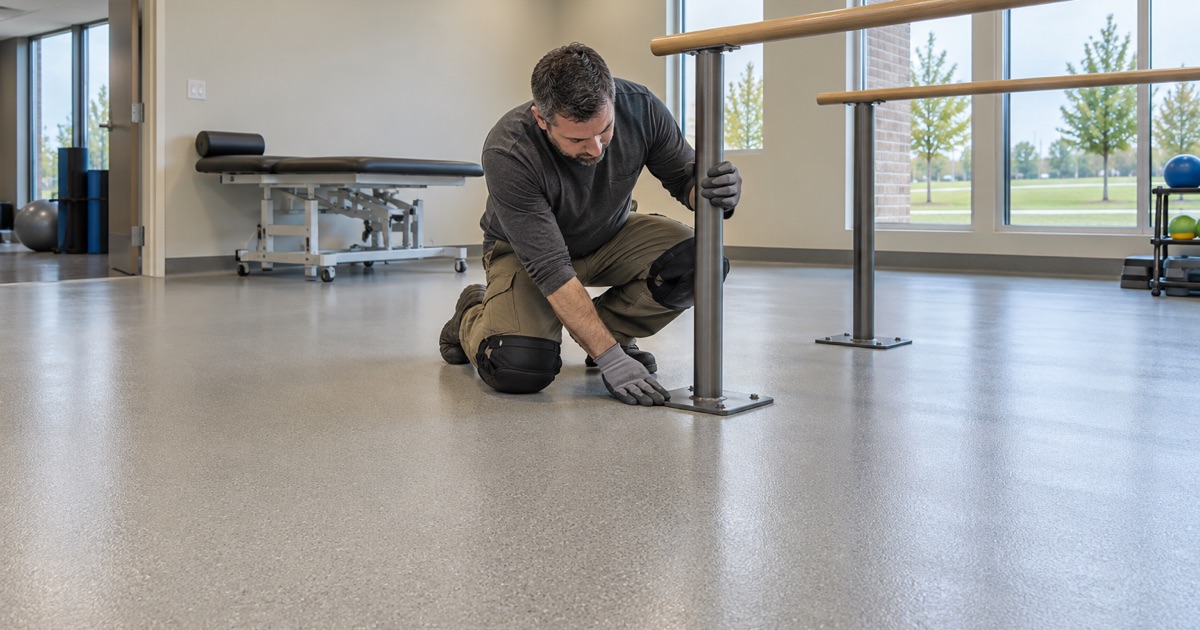
A therapy gym is full of things that must not move: parallel bars, treatment tables, stair trainers and exercise machines. Apartment-style rooms where patients practice daily tasks bring the wet and greasy conditions of a real home. Each of those spaces asks something different of a coated floor, and we plan them separately rather than running one system through the whole building.
Equipment bolted through the floor
When parallel bars or a stair trainer are anchored to the slab, the anchors pass through the coating. We prefer to know the layout before we coat, so anchor holes are drilled into the cured system and sealed, or the equipment is set first and the coating is worked tightly around its base plates. Either way the edge is closed, not left open to lift.
Moving equipment later is the common problem. Old anchor holes are filled and patched flush, and the patch is textured to match, so abandoned holes do not become catch points for a cane tip or a caster. We record anchor locations on the job drawings, so the next layout change starts with a map.
Practice kitchens and bathrooms that mimic home
A practice kitchen in any rehab setting sees the spills of any kitchen, and a practice bathroom sees standing water around a tub or shower. For rooms like those we look at an integral cove base, which carries the coating up the wall so there is no seam at the floor line for water to reach, plus a slightly firmer texture near wet fixtures.
Chemical resistance matters as much as grip. Disinfectants, soaps and cleaners are used heavily in clinical rooms, so we match the topcoat to the products the facility actually uses and confirm it in writing. Low-odor products are available where a building has to stay occupied, offered as a comfort choice rather than as a legal requirement.
Scheduling around patients and staff
Clinical floors rarely get a quiet month. We phase work room by room, using overnight and weekend windows where a space cannot close, and grinding dust is captured at the machine with a vacuum rather than swept or rinsed toward a drain. Cure schedules follow slab temperature and dew point, so a room returns to service when the coating is ready, not when a calendar says so.
Bringing the same thinking home
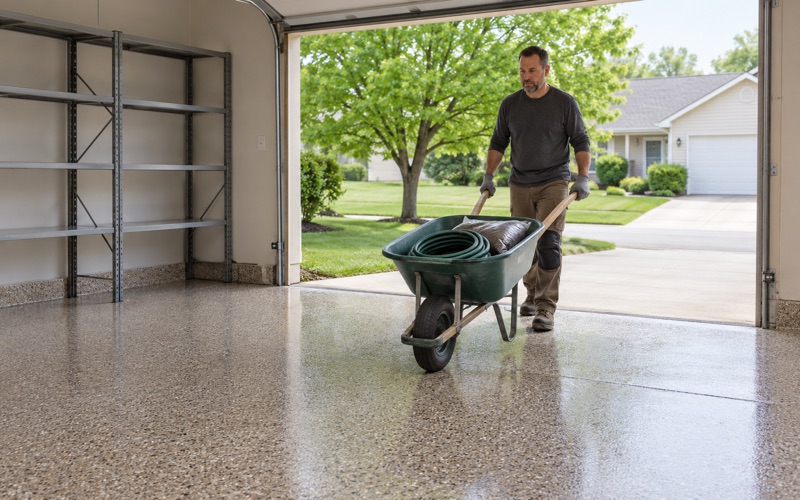
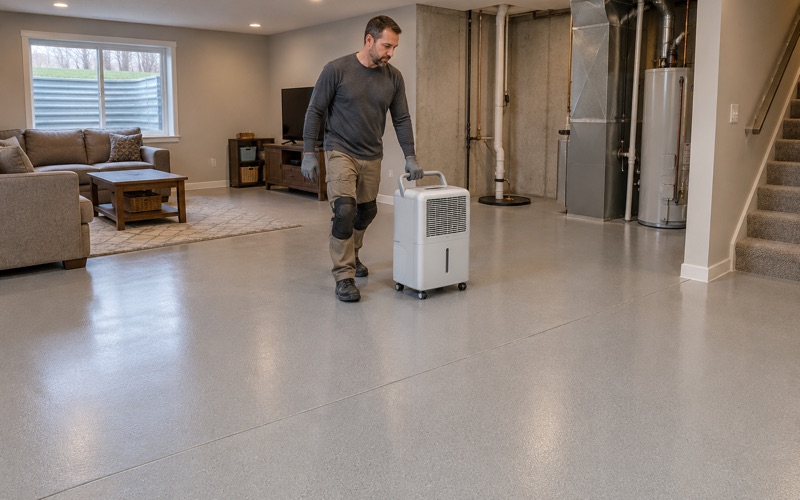
The same priorities carry into houses. Most homes in Clive are owner-occupied and detached, with the largest share built in the 1990s, and a family adapting a garage entry or basement for a walker or wheelchair can ask for the same things: a firm, seamless surface, a controlled texture and a written moisture test, whatever year the house was built.
- 20+ Years on Iowa Concrete
- Moisture Tested in Writing
- Free Estimates