Ames Epoxy Flooring has spent more than 20 years on concrete coatings, and our epoxy flooring in Bondurant starts with a question most basement jobs never ask: what did the builder already put into this slab? Many local basements carry a passive radon-resistant system in their joints, plumbing openings and sump, and our work is to coat that floor without undoing any of it.
That changes how we price the job. Before a number goes on paper we walk the floor and note every sealed joint, caulked pipe, gasketed lid and vent pipe, then write down whether each will be protected, resealed or simply left alone. The proposal also names the product line, the number of coats and the finished thickness, so the completed floor can be checked against what we quoted.
One thing comes first because it shapes the rest. A floor coating is not radon work, and we never sell it that way. In Iowa, radon testing and mitigation require a state credential under Iowa Code chapter 136B, which we do not hold. What we deliver is a durable, cleanable basement floor that leaves the existing system exactly as serviceable as we found it.
Bondurant’s Radon-Resistant Basements
A local requirement that came before the state’s
Bondurant is a city in Polk County and part of the Des Moines–West Des Moines metro, and it has grown quickly, from 3,860 residents in 2010 to 7,365 in 2020. According to Iowa HHS, it was one of 11 Iowa jurisdictions that required radon-resistant new construction in new single-family houses before a passive method became a statewide requirement on July 1, 2026.
Those local rules pointed to Appendix F of the International Residential Code, the same family of methods the state now references. The whole of Iowa sits in radon Zone 1 on the code’s own map, which is why the appendix spells out how a slab, its openings and its sump are to be built. We read that text the way a coater should: as a list of parts not to damage.
A housing stock built mostly after 2000
The American Community Survey counts 74.8 percent of Bondurant’s housing units as built in 2000 or later, and 52.8 percent in 2010 or later. That is a large share of basements poured under modern codes. Still, we never assume a particular house was built under the local radon rule, because the ordinance’s effective date is not something we have confirmed. We look at the floor itself.
When we find the system, it goes on the same floor map as cracks, spalls, joints and any old coating. When we find none, we say that too, and the job proceeds as an ordinary basement coating. Either way, a moisture test sits in the written scope before the price is final, since a newer house is not automatically a drier basement.
What we look for on the first visit
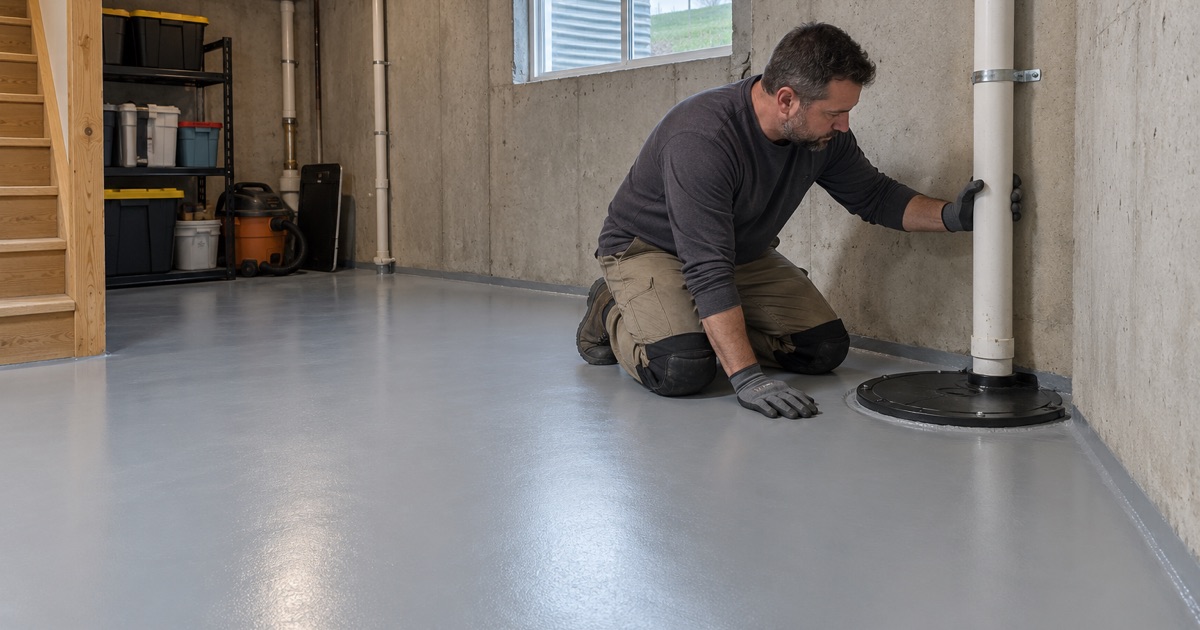
A radon-resistant basement usually shows its parts plainly. There are sealant lines running down control joints and along the edge where the slab meets the foundation wall, caulk rings around plumbing that rises through the floor, a sump with a sealed or bolted cover, and a pipe of about 3 inches climbing from the floor toward the roof.
We also check the sump pit and floor drain for signs of past water, such as staining, efflorescence or a high-water line on the pit wall. A coating does not stop seepage or hydrostatic pressure, so a basement with a history of water needs that answered before any resin is mixed. If a slab needs repair before it should be coated, we tell you plainly.
Looking for epoxy-flooring closer to Grimes? See Grimes Epoxy-Flooring.
What the Builder Sealed: Joints, Penetrations and the Sump Lid
Joints filled with elastomeric sealant
Appendix F, section AF103.4.2, says control, isolation and construction joints, and joints between slabs and foundation walls, shall be sealed, with gaps cleared of loose material and filled with polyurethane caulk or other elastomeric sealant. That bead is soft on purpose. It stretches as the slab shrinks, curls and moves with the seasons.
A rigid epoxy laid straight across that bead cannot move with it. The coating cracks along the joint line, and the sealant beneath can tear loose from the concrete. So we never bridge a sealed joint rigidly. Where the bead is sound, we coat up to its edges; where grinding opens it, we reseal with a compatible elastomer, and the finished joint reads as a joint, not a hidden fault.
Pipe penetrations and plumbing openings
Section AF103.4.1 covers the openings around bathtubs, showers, toilets, pipes, wires and anything else that passes through the slab. These are to be filled with polyurethane caulk or an equivalent sealant. In a finished basement they cluster near the bathroom rough-in, the water heater, the floor drain and the utility corner.
Our grinder works close to these rings but not through them. We hand-tool the last inch around each penetration, keep the existing sealant where it is still bonded and flexible, and replace it where it has cracked or pulled away. The coating then meets fresh, compatible sealant rather than a crumbling bead, which is better for the floor and for the builder’s intent.
The gasketed sump lid
Under section AF103.4.4, a sump pit that is open to the soil or that ends a drain-tile loop is covered with a gasketed or otherwise sealed lid. If the sump doubles as the system’s suction point, its lid is made to accommodate the vent pipe; if it serves as a floor drain, the lid has a trapped inlet.
That lid is a working part, not trim. The pump beneath it needs service, the float needs checking, and the gasket has to seat again afterward. We treat the lid, its fasteners and its seal as off limits to resin, and we plan the edge of the new floor so the cover lifts and closes exactly as it did before we arrived.
Grinding and Coating Without Breaking the Seals
A mechanical profile, never acid
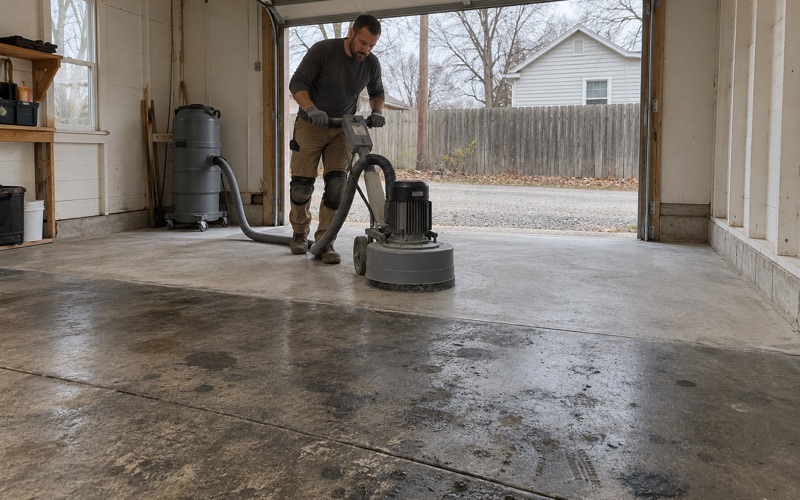
Every slab we coat is opened with a diamond grinder or a shot blaster. Acid etching is off the table, partly because it gives a weak profile and partly because flooding a basement with rinse water near sealed joints and a sump is exactly the wrong move. Coating makers set the target; Sika’s data sheet for Sikafloor-264, for example, calls for a profile equal to ICRI CSP 3 to 4.
The same data sheet lists what has to come off for a good bond: dust, laitance, efflorescence, old paint films, oils, grease and similar contaminants. We capture grinding dust at the machine with a vacuum rather than washing it toward the floor drain or sump, which keeps the pit clean and keeps fine concrete dust out of the pump.
Moisture testing before the price is final
A basement slab sits on soil, so moisture is the first thing we measure. Depending on the floor and the system planned, we use ASTM F2170 in-situ relative humidity probes or an ASTM F1869 calcium chloride test, and we read the result against the product’s limits. Where readings run high, a moisture-mitigation primer goes into the scope, priced before you sign.
We also explain what the coating warranty leaves out before the job is sold. Moisture vapor transmission and hydrostatic pressure are the exclusions we name first, because they are the ones that lift a basement floor. If a slab needs more than a primer can answer, we would rather say so on the first visit than after the resin has gone down.
Resealing the joints the grinder opens
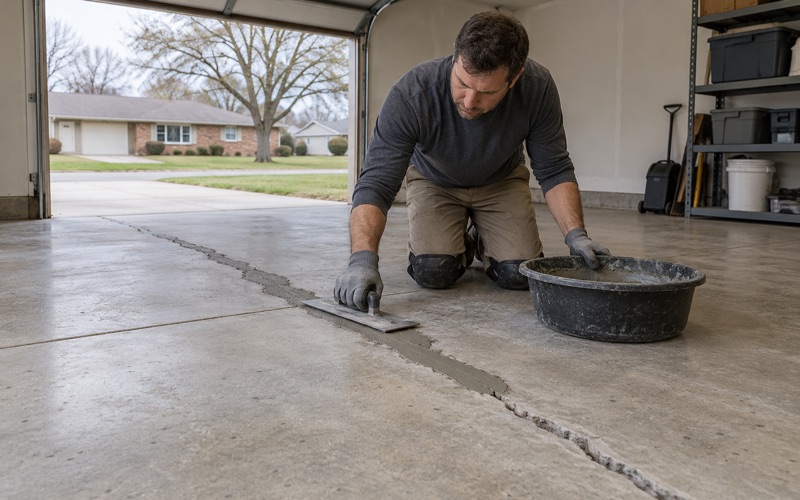
Grinding sometimes nicks a joint bead or exposes a void beside it. When that happens, we clean the joint back to sound concrete, clear the loose material and reseal it with a polyurethane or other elastomeric sealant chosen to work with the coating system. The sealant cures before the topcoat goes near it.
The coating then stops at the sealant or is cut back over it, so the floor and the joint can each move on their own. In practice the finished basement shows thin, clean sealant lines where the slab’s joints have always been. They are not flaws; they are the part of the builder’s work that was meant to stay flexible, and we keep it that way.
Curing on the slab’s schedule
We set cure times by slab temperature and the dew point spread at the surface, not by the calendar. Basements in central Iowa stay cool, and cool concrete slows epoxy and invites amine blush. Sika’s data sheet also warns that unvented heaters can cause blushing, whitening and debonding, so we do not use them to rush a cure.
For homes where the family stays in the house during the job, we offer low-odor products as a comfort and re-entry choice. That is a preference, not something Iowa law requires, and we describe it that way. We tell you before we start how long the basement should stay closed off and when it can take foot traffic and furniture again.
The Vent Pipe, the Sump and What a Coating Is Not
The labeled vent pipe stays untouched
Section AF103.6.1 calls for a gas-tight vent pipe of at least 3 inches, set into the aggregate below the slab or run through a sealed sump cover, and AF103.9 requires exposed interior vent pipe to carry the label ‘Radon Reduction System’ on each floor. In a basement that label is usually easy to spot on the pipe near the floor.
We mask the pipe and its floor penetration before grinding, keep the coating to the edge of the sealant ring, and never cut, move, box in or bury it. The label stays readable. If you choose an integral cove base along the walls, we stop it short of the pipe so the next person to work on the system can see and reach every joint.
Keeping the sump serviceable after a hard rain
The National Weather Service recorded 5.20 inches of rain in 24 hours four miles northeast of Bondurant during the July 2026 flash flooding. Rain like that is when a sump pump earns its keep, and a pump that cannot be reached quickly is a problem no floor finish can fix.
So the coating ends at the rim of the pit, the gasket stays clean and free of resin, and the lid still lifts without prying. We will also point out a pump, float or discharge that looks worn while we are there, though repairs belong to a plumber. A floor coating is not flood protection, and it does not keep groundwater out of a basement.
What a floor coating does not do
An epoxy floor in a radon-resistant basement is a finish laid over a system someone else designed and built. It is not mitigation, it does not take the place of the builder’s sub-slab plastic or sealing, and it should never be read as a soil-gas retarder. We make no claim at all about radon levels before or after the work.
Whether to retest after a basement renovation is the homeowner’s decision, made with a credentialed radon professional, not with a coating crew. What we can promise is narrower and real: a ground, primed and coated floor whose joints are still flexible, whose sump lid still seals, and whose vent pipe stands exactly where the builder left it.
- 20+ Years on Iowa Concrete
- Moisture Tested in Writing
- Free Estimates