
Ames Epoxy Flooring installs basement floor epoxy in Ames, IA, serving surrounding cities including Huxley, Nevada, Polk City, Boone and Ankeny. A basement floor is the hardest slab in the house to coat well, because it sits below grade, against the ground, where water and vapor have the most chances to work their way up through the concrete.
That is why our basement work begins with the water question rather than the color question. We look at the floor’s history, check the sump pit and floor drain, and run a moisture test that becomes part of the written scope before any price is final. A coating laid over a slab that is still pushing moisture will blister and release, however good the product.
In more than twenty years of coating central Iowa concrete, we have found that most basement coating failures were predictable before the first coat went down. Our job is to find those signs early, tell you about them plainly, and then build a floor that the slab can actually carry, or tell you when the slab is not ready yet.
Reading a Basement Before It Is Coated
Water History and Signs of Seepage
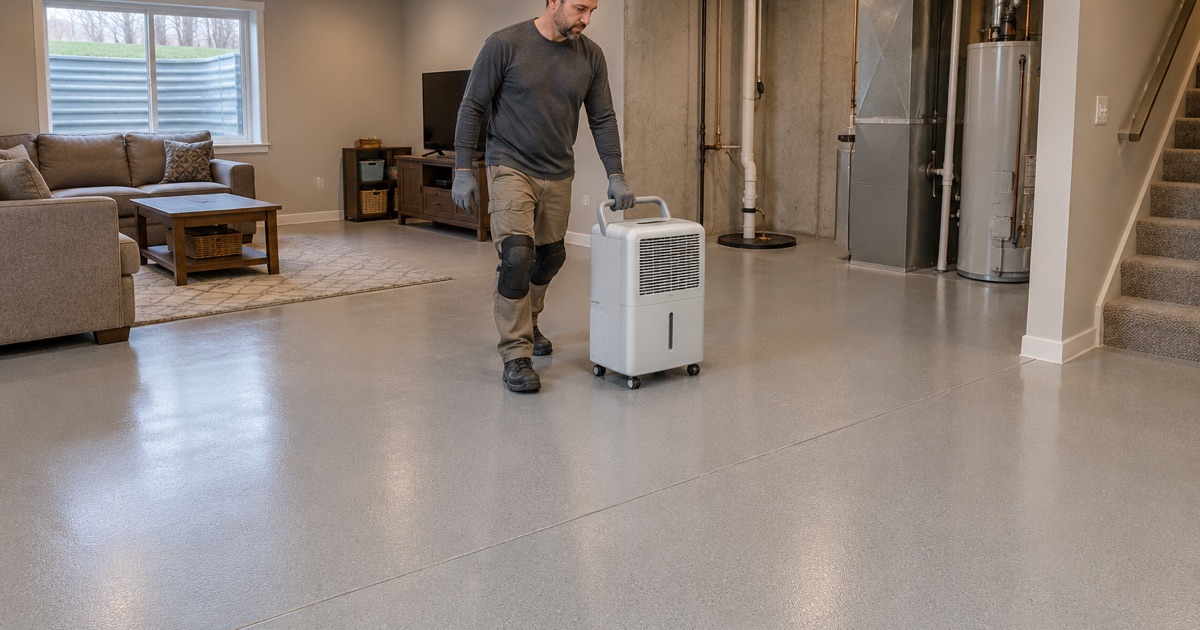
We start by asking what the basement has been through: past water, a wet spring, a sump that ran constantly, or a flood. Stains along the base of the walls, rust on appliance feet, and tide lines on old paint all tell part of that story, even when the floor looks dry on the day we visit.
Many Ames basements sit in Des Moines Lobe glacial till, and how wet that ground stays changes from one lot to the next. A basement that took water in the past is more likely to take it again, which shapes both the system we recommend and the warranty conversation.
Sump Pits, Drain Tile and Floor Drains
The sump pit, drain tile and floor drain are the basement’s defense against water, and the coating has to work around them. We confirm the sump pump runs and the floor drain flows before the job begins, because a coating does nothing to move water out of a basement.
During the install, the coating is finished neatly at the pit and around the drain body. Nothing that needs to be opened, cleaned or serviced is sealed over, and the floor around the drain keeps its slope so water still finds it.
Efflorescence and Hydrostatic Pressure
A white, chalky crust on a basement floor is efflorescence: mineral salts left behind as moisture moves up through the concrete and evaporates. It shows the slab is passing water, and any coating laid on top of it loses its bond to the concrete underneath.
Where groundwater presses up against the slab, that hydrostatic pressure can push water through cracks and joints and lift a coating from below. No coating holds that back. Drainage repairs come first, and we will tell you if that is where the money should go before a floor coating.
Moisture Testing and Mitigation
Testing Methods We Use
Our first screen is the ASTM D4263 plastic sheet test, which shows whether moisture is collecting under a sealed patch of the floor. When a result is borderline or the stakes are higher, we move to calcium chloride testing under ASTM F1869 or in-situ relative humidity probes under ASTM F2170.
The readings are compared against the product maker’s limits, and the result is written into your scope. That way the system we price is the one the slab can handle, rather than one chosen before anyone knew how wet the concrete was.
Moisture-Mitigation Primers
When a slab tests above what a standard epoxy can tolerate, a moisture-mitigation primer goes down first. It is formulated to hold back vapor moving through the concrete and give the decorative coats above a stable surface to bond to.
A mitigation primer adds material and a step, so we specify it only when the readings call for it. It is designed for vapor drive, not for liquid water under pressure, which is why drainage problems are solved first.
What the Warranty Leaves Out
Nearly every floor coating warranty excludes failures caused by moisture vapor transmission and hydrostatic pressure. Many also exclude slab movement and damage from standing water. Moisture is the first exclusion we name, before you sign anything.
Knowing that up front changes how you think about a damp basement. If the slab tests high, we would rather talk about mitigation or drainage now than have you discover the fine print after the floor starts lifting.
Older Basement Floors in Ames Homes
Paint, Patching and Tile Adhesive
Older basements often carry layers of paint, patching compound, and black tile adhesive left behind when an old floor covering was pulled up. All of it has to be ground off so the new coating bonds to sound concrete rather than to a layer that may already be loosening.
Some older adhesives contain asbestos, so black mastic may need to be tested before anyone grinds it. We raise that before quoting, and the removal is priced as its own line on the proposal.
Uneven, Cracked and Patched Slabs
Old basement slabs are often uneven, with low spots near the drain, cracks from settling, and patches from past plumbing work. Cracks are filled and ground flush, and low spots that hold water away from the drain can be built up before coating.
Where a slab has broken into pieces or moves under foot, a coating will crack along the same lines. In that case, we tell you the area should be repaired or replaced first rather than coated over.
Rental Houses and Duplex Basements
Ames has many older houses and duplexes rented to tenants, and their basement floors often carry decades of wear. Ames rental inspections under Municipal Code Chapter 13 look for a nonabsorbent toilet-room floor surface, and a coated floor can help a basement bathroom meet that standard.
We schedule rental basements around lease turnover, so the floor is coated, cured and ready before the next tenant moves in. The proposal sets out the cure time, so landlords can plan the move-in date.
Basement Rooms and Finish Choices
Laundry Rooms and Utility Areas
Laundry rooms see water from washers, detergent spills and the occasional overflow. A coated floor with a light texture handles that and wipes clean, and the coating stops at the floor drain without blocking it.
Utility areas around furnaces and water heaters get a durable, plain finish that makes leaks easy to spot. That early warning is one of the most practical benefits of a light-colored coating in a basement.
Home Gyms, Workshops and Family Rooms
Home gyms and workshops need a floor that handles dropped weights, tools and rolling equipment. A flake or quartz broadcast adds grip, and rubber gym mats sit well on a fully cured coating.
Family rooms and finished spaces often suit a metallic epoxy or a fine flake blend that looks finished rather than utilitarian. Whatever the finish, the moisture work underneath is the same.
Low-Odor Products for Occupied Homes
Basements have less airflow than the rest of the house, so odor during installation matters more. We offer low-odor products and plan ventilation and re-entry times with you before the job starts.
Low-odor products are a comfort choice, not something Iowa law requires for a home. We explain the trade-offs in cure time and cost so you can decide.
What a Basement Coating Is Not
Not Waterproofing
A coating seals the surface of the floor, but it does not stop water from entering a basement. Seepage through walls or cracks, and water pushed up by hydrostatic pressure, are drainage problems that need drainage solutions.
After the August 2010 flood on Ioway Creek and the South Skunk River, many Ames homeowners learned how a coated floor helps with cleanup. It is easier to clean once water recedes, but it does not keep floodwater out.
Not Radon Mitigation
A floor coating is not radon mitigation, and we never sell it as one. In Iowa, radon testing and mitigation require a state credential under Iowa Code chapter 136B.
If you are concerned about radon, a credentialed tester or mitigator is the right first call. A coating can go down after any mitigation system is in place, finished around the pipe and fittings.
- 20+ Years on Iowa Concrete
- Moisture Tested in Writing
- Free Estimates