Ames Epoxy Flooring brings more than 20 years of epoxy-flooring work to Altoona, and on this page we focus on the floors that carry wheels all day: distribution warehouses, shop bays and loading areas where the slab is cut into panels and every joint takes a hit. On those floors our job is less about color and more about keeping joint edges whole.
Before we price anything, we walk the floor and map cracks, spalls, joints and any old coating, and we tell an owner plainly when a section needs repair before it should be coated. The written proposal then names the product line, the number of coats and the finished thickness, so the completed floor can be checked line by line against what was quoted.
Cure schedules follow slab temperature and the dew point spread at the slab surface rather than the calendar. In a big building with dock doors cycling open through a central Iowa winter, the concrete can sit well below the air in the office, and that gap decides when a coat can go down and when the work has to wait.
Altoona’s New Distribution Floors and What Their Joints Carry
A warehouse town in the Des Moines metro
Altoona, a Polk County city on the east side of the Des Moines metro, added a great deal of industrial floor in a short time. Altoona Now reported roughly 2.7 million square feet of warehouse space built or under construction in 2023, and the city’s 2023 annual report counted more than 2 million square feet of new warehouse space in its expansion.
The same reporting described approximately 1,600 acres of development-ready land, so the pattern is likely to continue. For an owner or a property manager, that means a lot of fresh concrete reaching its first years of service together, and the joints in a newer Altoona warehouse deserve a maintenance plan from the start rather than a first look only after something breaks.
The spec buildings on the market
Broker listings give a sense of the floors involved. The Altus Commerce Center’s Building A, at 2600 20th Avenue SW, is listed at 265,700 square feet, built in 2022, with a 7-inch reinforced slab over a vapor barrier. The first building at the I-80 Distribution Center is listed at 300,000 square feet with a 32-foot clear height and a 7-inch slab.
Those figures come from listings, not engineering drawings, and one listing gives two different completion years, so we treat them as a description rather than a specification. We have no relationship with the developers or tenants of either building. What the listings do show is the kind of floor common here: large, thick slab-on-ground panels laid out for racking and dock traffic.
What a forklift does at a saw cut
Every saw-cut contraction joint is a narrow gap with two square edges. When a forklift or pallet jack rolls across, its hard wheels drop slightly into the gap and strike the far edge. Repeated over and over through every shift, that impact chips the edge, and a chipped edge becomes a wider gap that catches the next wheel even harder.
The Concrete Polishing Council’s Position Statement #4, published in Concrete International in May 2020, states the purpose of a joint filler directly: to protect saw cut contraction or construction joint edges from spalling or degrading under wheel impact from material-handling vehicles and pallet jacks. The filler supports the edge so the wheel rolls over a nearly continuous surface instead of a slot.
Looking for epoxy-flooring closer to Perry? See Epoxy-Flooring Services in Perry.
Semirigid Joint Filler and Why It Lets Go
Epoxy and polyurea fillers
On a forklift floor the joint filler is usually a semirigid epoxy or polyurea, hard enough to carry a wheel and still slightly flexible. It is placed full depth in the saw cut and shaved flush with the slab, so the wheel crosses one plane instead of dipping. A soft, caulk-type sealant does not support an edge this way, which is why distribution floors get the firmer material.
Polyurea fillers set quickly, which helps when a joint has to be back in service within the same shift. Epoxy fillers are usually slower to set and somewhat stiffer once cured. Either way, the material is written into our proposal along with the joint runs it covers, so the owner knows exactly what went into each line on the floor.
The slab keeps shrinking
Concrete slabs-on-ground lose volume as they dry, and they keep doing it long after the building opens. Position Statement #4 quotes ACI 302.1R-15: most shrinkage takes place within the first 4 years, and the most significant shrinkage happens within the first year, especially the first 90 days. Each panel shortens, and each joint between panels opens a little wider.
The same statement notes that slab shortening is accelerated when the building’s HVAC system is activated. A new warehouse running its heating and air handling for the first time dries its slab faster, and the joints respond. Reinforcing steel running through the joints and friction against the base, including whether a vapor retarder sits underneath, also affect how far a given joint widens.
Separation is expected, not a defect
As a joint opens, the semirigid filler is stretched until it lets go, either pulling off one joint face or splitting down its middle. The Council’s statement, citing ACI guidance, says separation should be expected when joints are filled early, that it does not indicate failure, and that repairing a joint filled before 28 days is a floor maintenance issue rather than a warranty issue.
We explain this before a job is sold, the same way we explain what any coating warranty leaves out. An owner who knows separation is coming can plan for it in the maintenance budget instead of reading a hairline gap along a filled joint as a contractor’s mistake. A filler or a coating never stops a slab from shrinking; it only manages what that movement does to the floor.
Inspecting and Refilling Joints Before Edges Spall
What we look for on a walk-through
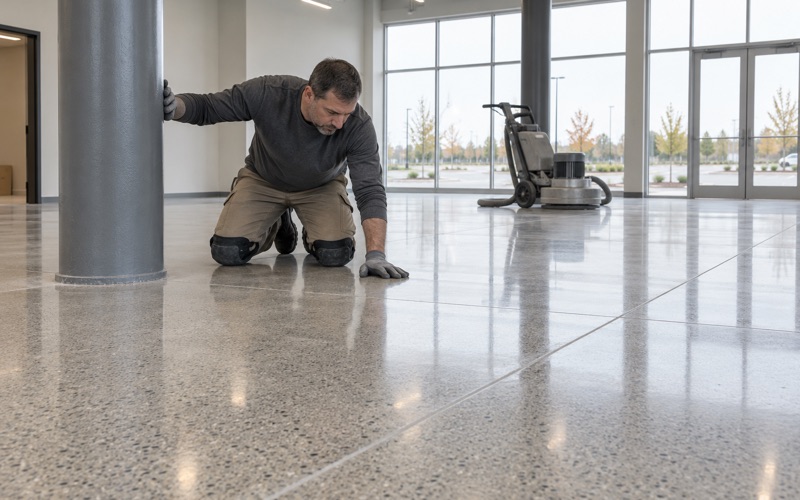
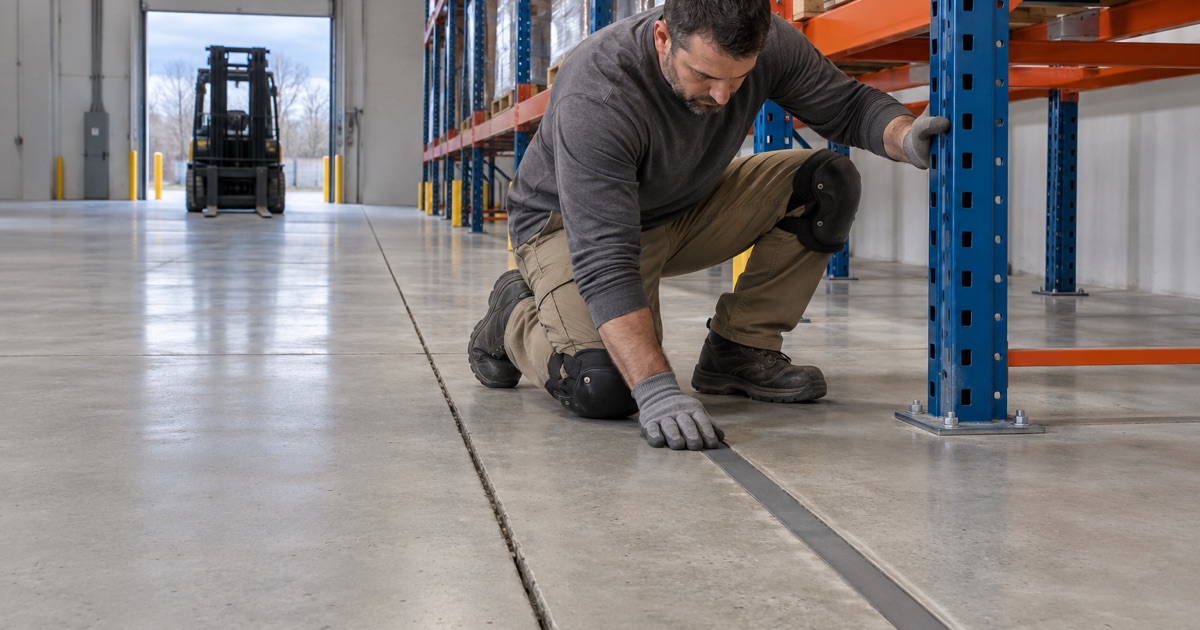
A joint inspection follows the forklift routes first: dock aprons, main aisles and the turns at the ends of racking rows. We look for filler pulled away from one face, filler split down the center, filler sitting below the slab surface, and any edge already starting to chip. Each finding is marked on a floor plan so the owner sees the pattern rather than a list.
A gap along the filler is the early warning. Once a wheel can drop into that gap, the unsupported edge starts to break, and a small chip grows into a spall that every passing pallet jack can feel. Catching the problem at the gap stage means the repair is a straightforward refill; catching it later means rebuilding the edge first.
Refilling a separated joint
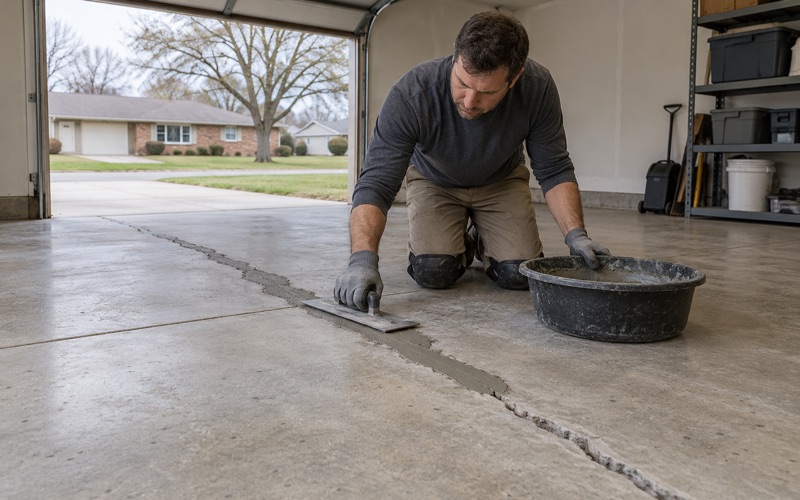
Refill work starts by cutting out loose or debonded filler and cleaning the joint faces back to sound concrete. Where filler has pulled off only one side, we remove enough of it to reach a clean bond line. New semirigid filler then goes in full depth and is shaved flush once it sets, so the wheel path is level again.
Timing matters here. Because the slab keeps shrinking through its early years, a joint refilled after the first round of opening usually stays tighter than the original fill did. On a busy floor we work in short runs, closing off one aisle at a time, and we plan overnight and weekend windows where receiving and shipping cannot stop.
Repairing edges that already broke
Where an edge has already spalled, filler alone will not hold. The broken concrete is saw-cut back to a square shoulder, cleaned, and rebuilt with an epoxy repair mortar before the joint is re-formed and filled. We say so in the proposal when a run of joints has reached this stage, because pricing it as a simple refill would hide the real scope.
Grinding and saw-cutting dust from this work is captured at the machine with a vacuum. It is never rinsed toward a floor drain, a trench drain or a storm inlet at the dock, which matters on a warehouse floor where wash water tends to run straight for the apron and out of the building.
Coating a Warehouse Floor Without Burying Its Joints
Preparing the slab
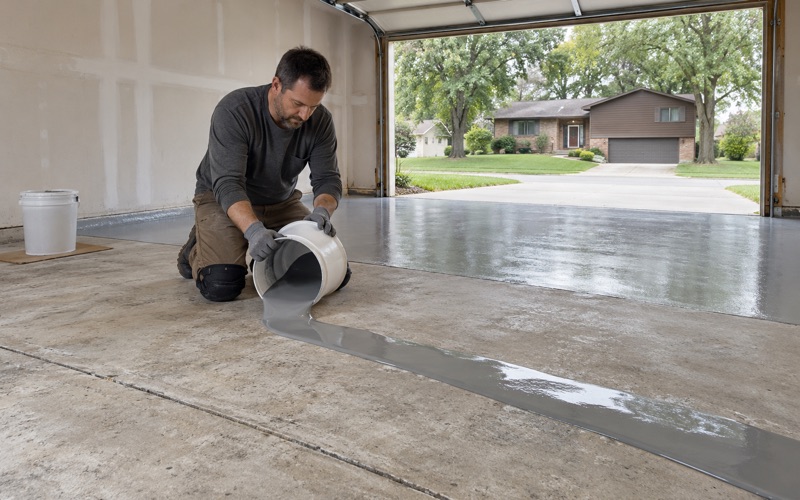
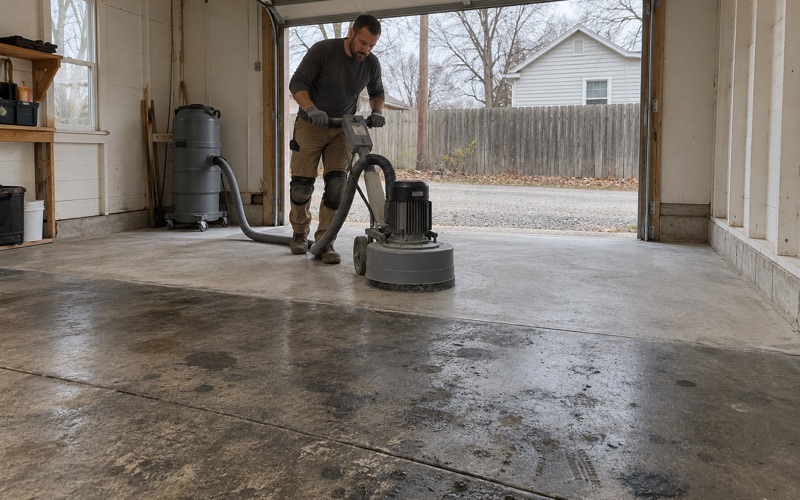
When an Altoona owner wants a coated floor in a shop bay, a packing area or a full warehouse aisle, the slab is opened with a diamond grinder or a shot blaster to a measured ICRI concrete surface profile. We never acid etch. A real profile is what lets a 100% solids epoxy grip the concrete under wheel traffic, and an ASTM D4541 pull-off test can confirm the bond afterward.
Moisture testing is part of the written scope before the price is final. A vapor barrier under a slab keeps ground moisture down, but it also means the concrete dries mostly upward, so we read relative humidity with ASTM F2170 in-situ probes. Where the readings call for it, a moisture-mitigation primer goes down before the build coats.
Honoring every joint
A coating laid continuously across a moving joint will crack along that line as the slab shortens, so we never bury the joints. Contraction joints are filled with semirigid filler and the coating is finished to it, or the joint is re-cut through the coating so the panel edges stay independent. Either way, the joint layout of the slab remains the joint layout of the finished floor.
That choice is made joint by joint, not building by building. Construction joints and saw cuts that have stopped moving can be treated differently from those still opening, and we map which is which before any coating goes down. The proposal lists the approach, so the owner can confirm later that the joints were handled the way the quote said.
Texture, topcoats and traffic
Forklift aisles, walk paths and dock aprons often need different finishes. A quartz aggregate broadcast under the topcoat gives real grip where people walk, and we specify slip resistance by the broadcast and topcoat used rather than promising it as a slogan. A polyurea or polyaspartic topcoat can be chosen where a fast return to service matters most.
No coating replaces joint maintenance. Even under a well-built system, the joints are still the part of a warehouse floor that moves, and they should be inspected on a schedule and refilled before their edges begin to spall. A clean, coated floor simply makes a separated joint easier to spot during that walk.
- 20+ Years on Iowa Concrete
- Moisture Tested in Writing
- Free Estimates